The Health and Growth of the U.S. Nonprofit Sector

Key Takeaways
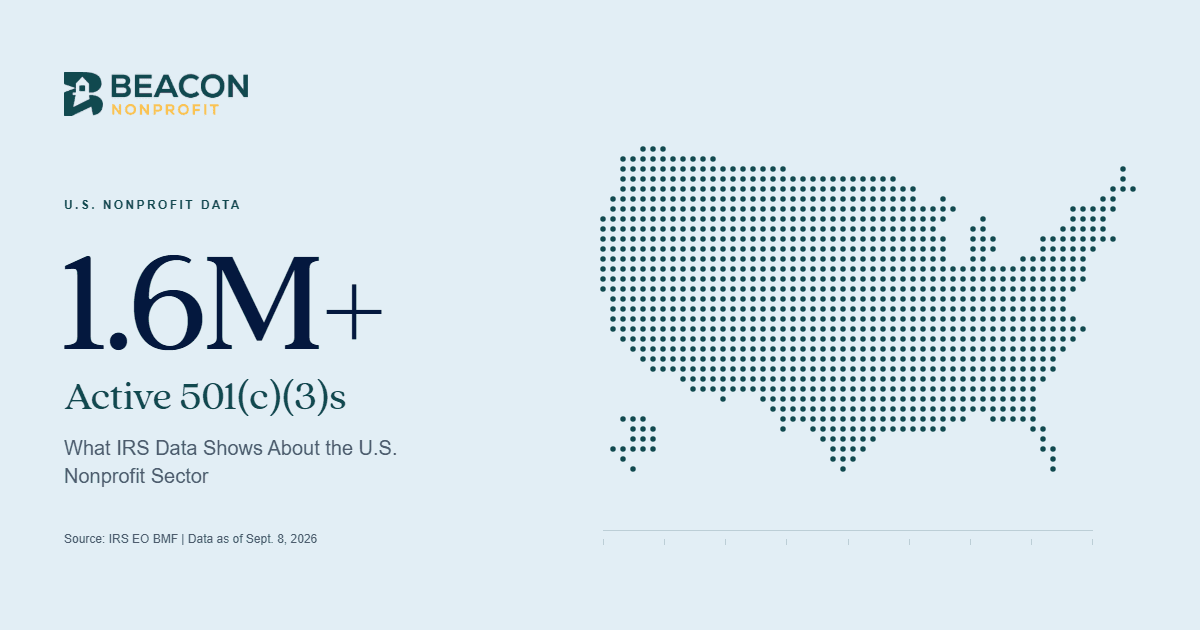
There are 1,636,144 active 501(c)(3) organizations registered with the IRS: a national rate of 47.87 per 10,000 residents, with significant variation by state.
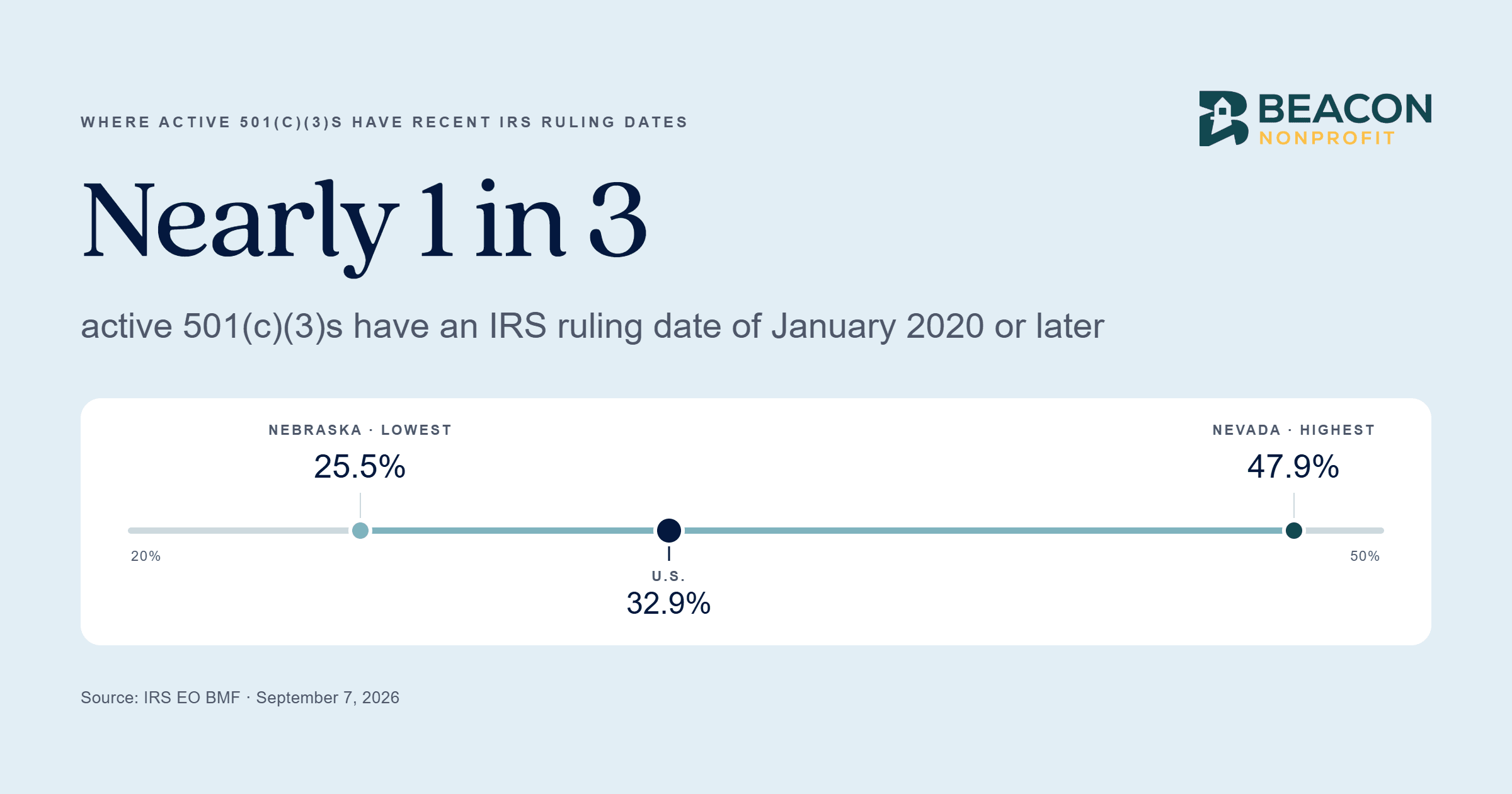
Nearly one in three currently active 501(c)(3)s received federal recognition since 2020, reflecting sustained interest in mission-driven work.
501(c)(3) organizations account for 83.8% of all active tax-exempt organizations in the U.S., far outnumbering any other classification.
Since 2010, the IRS has automatically revoked the tax-exempt status of 830,790 501(c)(3) organizations; only 15.8% have achieved reinstatement.
Maintaining 501(c)(3) status requires filing the correct annual IRS return every year; failure to file for three consecutive years triggers automatic revocation.
IRS data reveals a U.S. nonprofit sector of more than 1.6 million active 501(c)(3) organizations, and a third of them received federal recognition since 2020. Here's what the numbers show about sector size, composition, and long-term sustainability.
The U.S. nonprofit sector is larger than most people realize. More than 1.6 million 501(c)(3) organizations are actively registered with the IRS, and one in three of them received federal recognition since 2020.
But size alone doesn't tell the full story.
To understand what IRS data can tell us about America's nonprofit sector, you need to look at three things together: how many organizations exist and where they're concentrated, what kinds of organizations the IRS recognizes and why, and how well the sector sustains itself over time. IRS data can't measure every dimension of sector health (financial stability, employment, giving, or organizational capacity, for example), but it can tell us a great deal about the sector's size, composition, recent formation activity, and ability to maintain tax-exempt status. We analyzed the data across all three dimensions. Here's what it shows.
Is the U.S. Nonprofit Sector Growing?
Quick Answer
IRS data shows a large and active U.S. nonprofit sector, with more than 1.6 million 501(c)(3) organizations currently registered and nearly one in three receiving federal recognition since 2020. That suggests continued strong interest in forming mission-driven organizations. At the same time, maintaining tax-exempt status remains an ongoing challenge. More than 830,000 501(c)(3) organizations have had their status automatically revoked since 2010, and only 15.8% of revoked organizations have achieved reinstatement.
What Does IRS Data Show About the U.S. Nonprofit Sector?
As of September 8, 2026, there are 1,636,144 active 501(c)(3) organizations registered with the IRS: a national rate of 47.87 per 10,000 residents. Nearly one-third of currently active 501(c)(3)s received federal recognition since 2020. The sector spans all 50 states and Washington, D.C., with significant variation in concentration by state. 501(c)(3)s represent 83.8% of all active tax-exempt organizations nationally.
How Large Is the U.S. Nonprofit Sector?
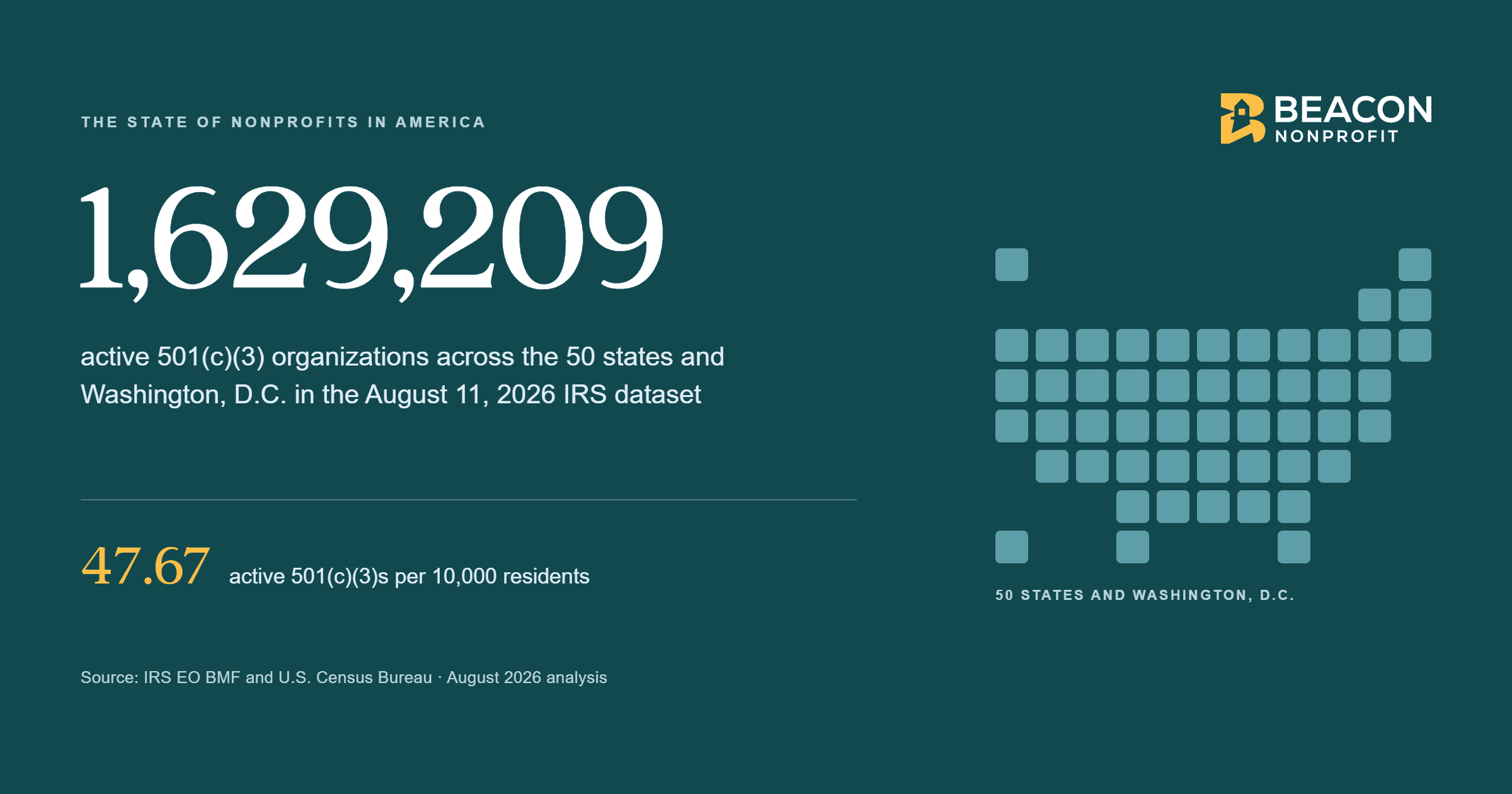
According to the IRS Exempt Organizations Business Master File and U.S. Census Bureau Vintage 2025 population estimates, as of September 8, 2026, there are 1,636,144 active 501(c)(3) organizations registered with the IRS, a national rate of 47.87 organizations per 10,000 residents.
That number is significant. But averages can be misleading because the nonprofit sector is not evenly distributed across the country.
The District of Columbia has the highest concentration of nonprofits in the nation: 157.20 organizations per 10,000 residents. Utah has the lowest, at 32.00 per 10,000. California has the largest total number of nonprofit organizations of any state — 177,324 — but ranks 38th in density because its population is so large. Alaska has the smallest raw count at 4,720 organizations. Wyoming, with 4,928 organizations, ranks 4th in the country for density despite having one of the smallest total counts in the nation.
The takeaway: raw count and concentration tell very different stories depending on the state. A state with fewer total nonprofits may still be deeply invested in the sector relative to its population size.
For a full state-by-state breakdown, read our state by state analysis on the state of nonprofits in the U.S.[](https://www.beaconnonprofit.com/blog/state-of-nonprofits-in-america/)
A Large Share of Today's Nonprofits Are Relatively New
According to the IRS Exempt Organizations Business Master File, 32.9% of currently active 501(c)(3) organizations have IRS ruling dates from January 2020 or later. That means roughly one in three active nonprofits in the United States received federal recognition in the past six years.
It's worth understanding what an IRS ruling date actually reflects. It's the date an organization received federal tax-exempt recognition, not necessarily the date it was incorporated at the state level. Some organizations incorporate and operate for months or even years before applying for 501(c)(3) status. The ruling date marks federal approval, not birth.
What the data does show clearly is that a substantial share of today's active sector is relatively young. Nearly one-third of all currently recognized 501(c)(3) organizations completed the full formation process since 2020, a meaningful signal about ongoing interest in creating mission-driven organizations.
What Kinds of Tax-Exempt Organizations Make Up the Sector?
Not all tax-exempt organizations are the same. The IRS recognizes multiple types of nonprofit structures, each serving a distinct purpose, but the IRS recognizes dozens of tax-exempt classifications and the sector is heavily concentrated in one.
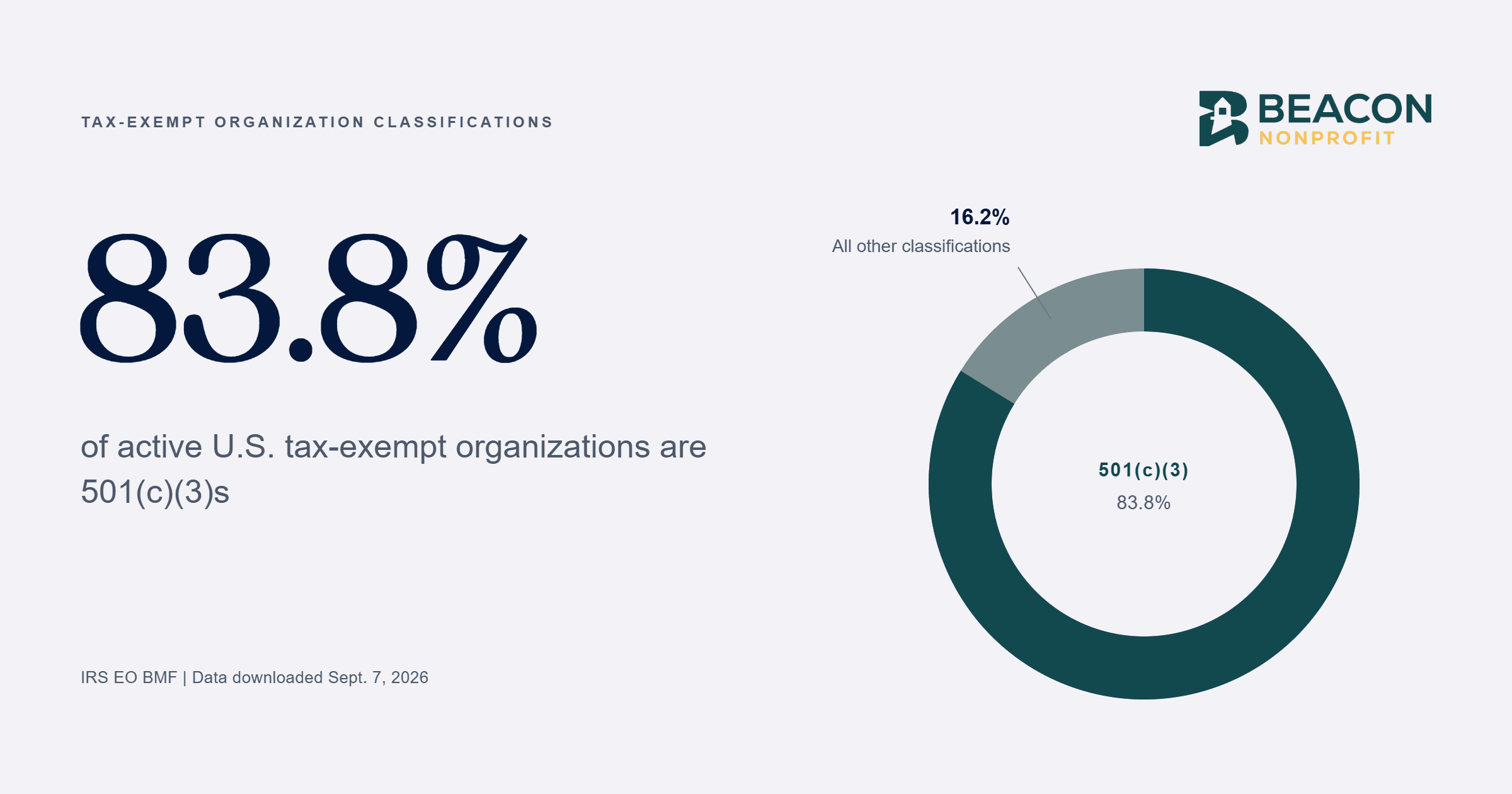
According to the IRS Exempt Organizations Business Master File, of the 1,956,822 active tax-exempt organizations in the United States, 501(c)(3) organizations account for 83.8%, or more than 1.6 million organizations. The four next-largest classifications combined represent only 11.1%:
- 501(c)(4) — Social welfare organizations: 68,417 (3.5%)
- 501(c)(6) — Business leagues and trade associations: 57,720 (2.9%)
- 501(c)(7) — Social and recreational clubs: 46,420 (2.4%)
- 501(c)(5) — Labor, agricultural, and horticultural organizations: 43,622 (2.2%)
Together, those five classifications account for 94.9% of all active tax-exempt organizations in the country.
The reason 501(c)(3) dominates isn't just tradition. The classification is specifically structured around charitable organizations, and qualifying contributions are generally tax deductible for donors, a feature that matters significantly to organizations seeking charitable donations, grants, or broad public support. Organizations that qualify can apply through Form 1023 or, for smaller organizations that meet certain criteria, the streamlined Form 1023-EZ.
For a deeper look at how the classifications compare and what shapes each one, read Tax-Exempt Organization Classifications: What the IRS Data Shows.
What Missions Are Nonprofits Pursuing?
Among 501(c)(3) organizations with a formal mission classification on file, three areas lead the sector according to the IRS Exempt Organizations Business Master File:
- Religion-related organizations: 15.8%
- Education organizations: 14.1%
- Human services organizations: 11.9%
These three categories reflect the oldest and most established roles nonprofits have played in American civic life: providing spiritual community, educational opportunity, and direct human services to people who need them.
One important caveat: 21.2% of active 501(c)(3) organizations carry no formal mission classification in IRS data. Churches and religious organizations are not required to apply for IRS recognition, which means the full scale of faith-based nonprofit activity may not be captured in these figures. The actual concentration of religion-related organizations is likely higher than the data shows.
What Does IRS Data Show About Nonprofit Compliance?
The age of today's nonprofit sector tells one part of the story. Sustainability tells another.
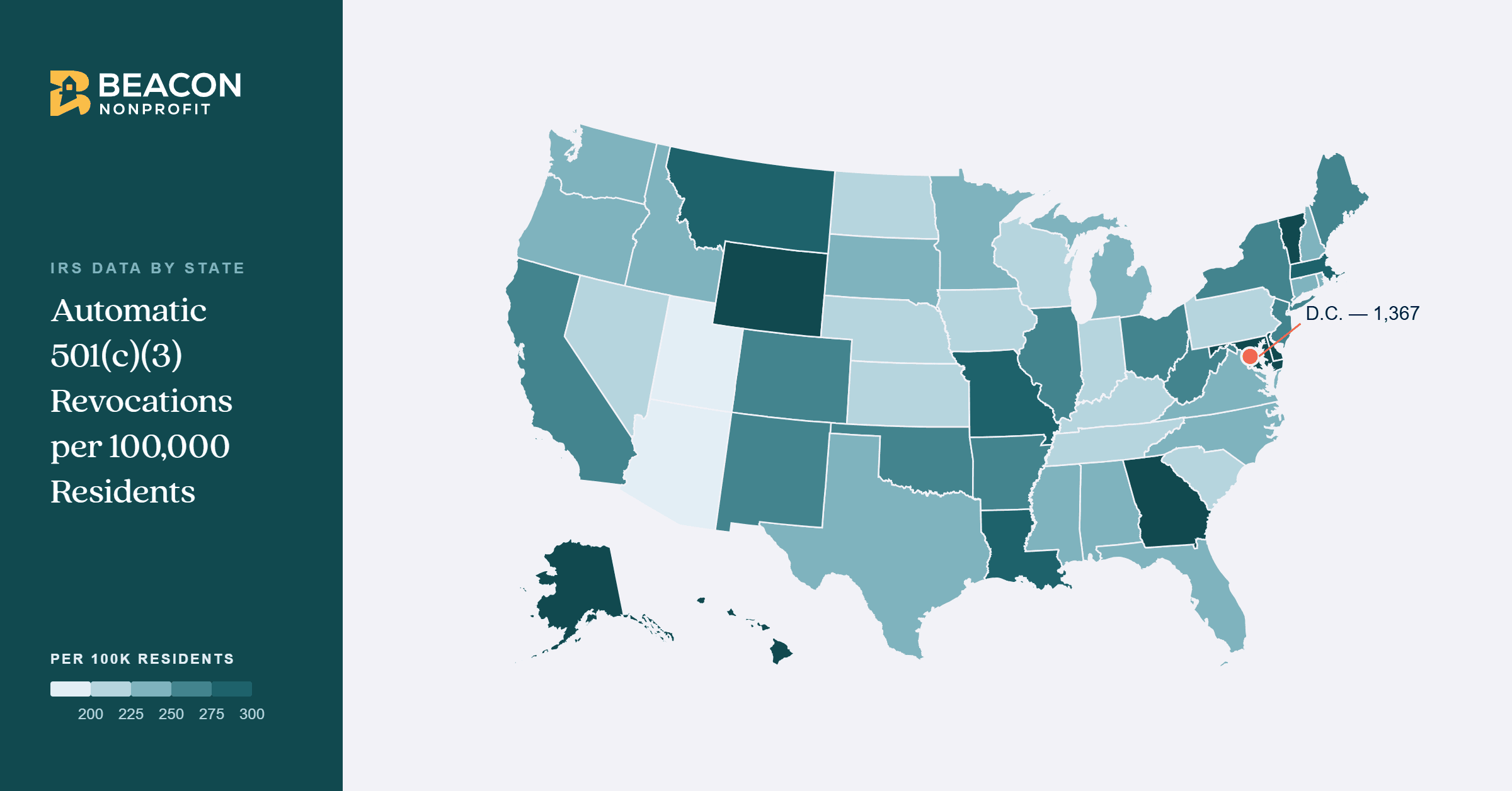
According to the IRS Exempt Organizations Automatic Revocation List, since 2010 the IRS has automatically revoked the tax-exempt status of 830,790 501(c)(3) organizations. That's more than half the number currently active.
Automatic revocation happens when an organization fails to file its required annual IRS return for three consecutive years. There is no audit, and no single warning letter triggers the revocation itself. The status is removed automatically once the threshold is crossed.
Annual revocations increased 73% between 2018 and 2024. In 2024 alone, 53,096 organizations lost their tax-exempt status, the highest single-year total on record since IRS data collection began in 2010.
Recovery is uncommon. According to the IRS Reinstatement guidance, only 15.8% of revoked organizations have achieved reinstatement. The remaining 84.2% show no reinstatement date in IRS records.
These numbers don't mean the sector is failing. Many revoked organizations were small, inactive, or had already wound down their operations before losing status. But they do reflect something real: the requirements for maintaining 501(c)(3) status are ongoing, and a meaningful number of organizations aren't meeting them.
For state-by-state revocation data and a look at what's driving the trend, read Automatic 501(c)(3) Revocations in America: IRS Data by State.
What This Means for Nonprofit Founders
If you're starting a nonprofit, these three dimensions of sector data are worth understanding before you begin.
The sector is large, and a significant share of it is relatively new. That reflects real and sustained interest in mission-driven work, and an established ecosystem of funders, legal resources, and organizational support to draw from. For founders, it also reinforces the importance of starting with a clear mission, building strong governance practices, and staying consistent with ongoing compliance.
501(c)(3) is the most common classification for charitable organizations. If your organization is formed for a charitable, educational, religious, scientific, or another qualifying purpose and expects to rely on charitable contributions or grants, 501(c)(3) status may be an appropriate path. The application process takes time, but the benefits, including the deductibility of qualifying contributions for donors and access to grant funding, are significant.
Maintaining 501(c)(3) status requires ongoing compliance. The revocation data makes this clear. Filing the correct annual IRS return each year, keeping your registered agent current, and maintaining accurate records are all part of what it means to run a nonprofit responsibly. Nonprofit Good Standing Requirements explains what that looks like in practice.
The good news: when you know what to expect, these requirements are manageable. The Nonprofit Compliance Checklist is a good place to start.
What Comes Next?
For a full state-by-state look at how nonprofits are distributed across the country, read The State of Nonprofits in America: A State-by-State Analysis.
To understand how tax-exempt classifications compare and what makes 501(c)(3) status the dominant choice, read Tax-Exempt Organization Classifications: What the IRS Data Shows.
For a breakdown of automatic revocation rates by state and what the numbers reveal about sector sustainability, read Automatic 501(c)(3) Revocations in America: IRS Data by State.
To see where active 501(c)(3)s have recent IRS ruling dates and what that reveals about the sector's age and formation trends, read Where Active 501(c)(3)s Have Recent IRS Ruling Dates: A State-by-State Analysis.
And if you're ready to start your own organization, How to Form a Nonprofit Organization in 8 Steps walks through the full process from beginning to end.
- IRS. Exempt Organizations Business Master File (EO BMF).
- IRS. Exempt Organizations Automatic Revocation List.
- IRS. Automatic Revocation of Exemption.
- IRS. Reinstatement of Tax-Exempt Status After Automatic Revocation.
- IRS. Types of Tax-Exempt Organizations.
- IRS. Charitable Organizations.
- IRS. Annual Filing and Forms.
- IRS. About Form 1023.
- IRS. About Form 1023-EZ.
- U.S. Census Bureau. Vintage 2025 Population Estimates.
Frequently Asked Questions
As of September 8, 2026, there are 1,636,144 active 501(c)(3) organizations registered with the IRS. Including all tax-exempt classifications, the total is 1,956,822 active organizations.
501(c)(3) organizations account for 83.8% of all active tax-exempt organizations in the United States. The next four largest classifications — 501(c)(4), 501(c)(6), 501(c)(7), and 501(c)(5) — together represent only 11.1%.
If a nonprofit fails to file its required annual IRS return (Form 990, 990-EZ, or 990-N) for three consecutive years, the IRS automatically revokes its tax-exempt status. There is no audit — the revocation is automatic once the threshold is crossed.
Yes, but it's uncommon. According to IRS data, only 15.8% of organizations that have had their status automatically revoked have achieved reinstatement. The reinstatement process typically requires filing a new application and paying a user fee.
The District of Columbia has the highest concentration of nonprofits in the nation at 157.20 organizations per 10,000 residents. Among states, Wyoming ranks near the top for density despite having one of the smallest total counts in the country.
Related Articles

Types of Nonprofit Structures Explained
Your legal structure shapes everything from how your board operates to how you apply for tax-exempt status. Learn the main nonprofit structures, what makes them different, and how to choose the right one for your mission.
The State of Nonprofits in America: A State-by-State Analysis
How does the nonprofit sector differ from state to state? This analysis of IRS and U.S. Census data compares active 501(c)(3) organizations by state, population, mission area, and IRS recognition date.
Tax-Exempt Organization Classifications: What the IRS Data Shows
According to Beacon Nonprofit's analysis of IRS Exempt Organizations Business Master File data, 501(c)(3) organizations account for 83.8% of all active tax-exempt organizations in the United States. This article breaks down how the major classifications compare, what the data shows, and how to think about classification when starting a nonprofit.
Automatic 501(c)(3) Revocations in America: IRS Data by State
See how automatic 501(c)(3) revocations vary across the United States, including state-by-state rates, historical trends, and what nonprofits need to know about maintaining tax-exempt status.

How to Apply for 501(c)(3) Tax-Exempt Status
Applying for 501(c)(3) tax-exempt status allows nonprofit organizations to receive tax-deductible donations and operate as federally recognized charities. This guide explains the steps required to apply, including forming a nonprofit corporation, obtaining an EIN, preparing governance documents, and submitting IRS Form 1023 or Form 1023-EZ.

Nonprofit Good Standing Requirements
Staying in good standing means your nonprofit has met its ongoing federal, state, and local requirements. This guide explains what those requirements are, why they matter, and how to make sure your organization stays on track.

Nonprofit Compliance Checklist: What Every Founder Needs to Know
Stay organized and protect your mission with this nonprofit compliance checklist. Learn which filings apply after formation, including annual reports, IRS Form 990, charitable solicitation registration, and more.

How to Form a Nonprofit Organization in 8 Steps
Starting a nonprofit organization is one of the most meaningful steps you can take for your mission, and it's more manageable than it might seem.
Where Active 501(c)(3)s Have Recent IRS Ruling Dates: A State-by-State Analysis
Nearly 1 in 3 active 501(c)(3) organizations in the U.S. have an IRS ruling date of January 2020 or later. Beacon Nonprofit's analysis of the IRS Exempt Organizations Business Master File reveals how that share varies across all 50 states and Washington, D.C.
Get Nonprofit Tips and Compliance Guidance
Subscribe for updates, insights, and resources that help you stay compliant and grow your mission.