Automatic 501(c)(3) Revocations in America: IRS Data by State

Key Takeaways
Since 2010, the IRS has automatically revoked the tax-exempt status of 830,790 501(c)(3) organizations, mostly for failing to file a required annual return for three consecutive years.
84.2% of revoked organizations have no reinstatement date in the IRS data, meaning most do not recover their tax-exempt status.
Annual revocations grew by 73% between 2018 and 2024, with 2024's total of 53,096 being the highest full-year total since the provision was first enforced.
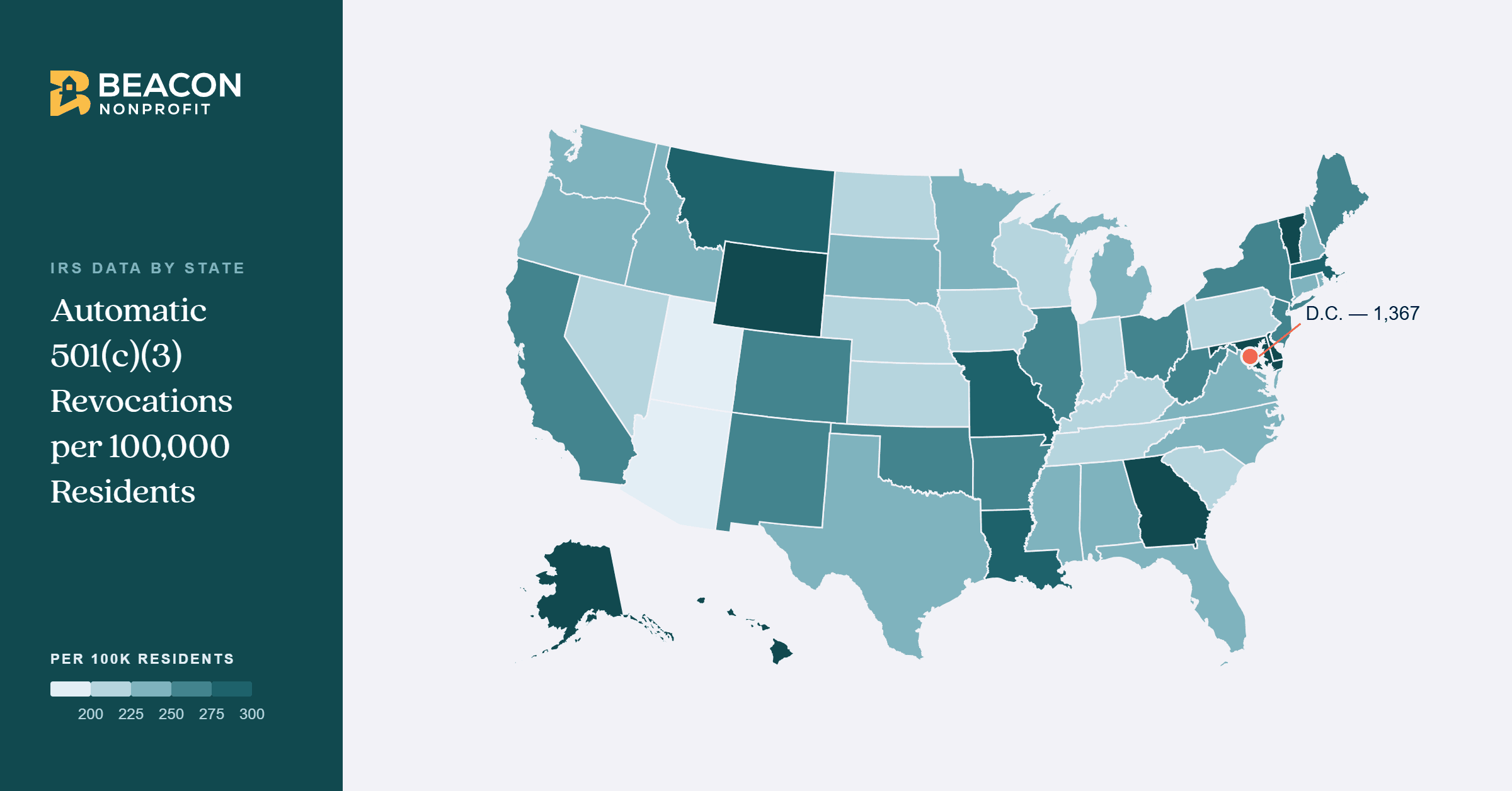
California leads all states with 100,790 revocations; Washington, D.C. has the highest per-capita rate at 1,322.3 per 100,000 residents, more than 5.5 times the national average of 242.0.
Automatic revocation is preventable: file the correct 990-series form every year, set deadline reminders, and keep your IRS contact information current.
See how automatic 501(c)(3) revocations vary across the United States, including state-by-state rates, historical trends, and what nonprofits need to know about maintaining tax-exempt status.
Since 2010, the IRS has automatically revoked the tax-exempt status of 830,790 501(c)(3) organizations across the United States. Most of these revocations happened for one reason: the organization failed to file a required annual return or notice with the IRS for three consecutive years.
This article presents an analysis of data from the IRS Exempt Organizations Automatic Revocation List as of September 8, 2026, broken down by state. Whether you're a new founder or managing an existing nonprofit, understanding this data can help you protect your organization's status. To learn more about how different nonprofit structures are set up and governed, see Types of Nonprofit Structures Explained.
How Many 501(c)(3) Organizations Have Had Their Tax-Exempt Status Automatically Revoked?
Quick Answer
Since 2010, the IRS has automatically revoked the tax-exempt status of 830,790 501(c)(3) organizations. Of those, 15.8% have a reinstatement date in the IRS data. Automatic revocation happens when a nonprofit misses its required annual IRS filing for three consecutive years.
What Is Automatic Revocation?
Most tax-exempt organizations are required to file an annual Form 990-series return or notice with the IRS. Depending on the size and type of your organization, that means filing a Form 990, 990-EZ, 990-PF, or 990-N. Under the Pension Protection Act of 2006, organizations that miss their required annual filing for three consecutive years lose their tax-exempt status automatically, by operation of law. No audit is required. No warning letter triggers the revocation. It happens on the due date of the third missed filing, and the revocation is posted publicly on the IRS Automatic Revocation of Exemption list.
Understanding what happens if a nonprofit misses a filing deadline is one of the most important things any founder can know.
Automatic 501(c)(3) Revocations: National Totals
The numbers are significant. Since 2010, the IRS has revoked the tax-exempt status of 830,790 nonprofit organizations. Of those:
- 131,366 (15.8%) have a reinstatement date in the IRS data
- 699,424 (84.2%) have no reinstatement date in the IRS data
When a 501(c)(3) organization is automatically revoked, it is no longer eligible to receive tax-deductible contributions. It will no longer appear as eligible in the IRS tax-exempt organization records. It may also be required to file a federal income tax return and pay applicable income taxes.
For context on the broader landscape of active nonprofits in the U.S., see The State of Nonprofits in America and The Health and Growth of the U.S. Nonprofit Sector: What the IRS Data Shows, companion research pieces covering sector size, composition, and compliance trends. For a closer look at ruling dates among currently active 501(c)(3)s, see Where Active 501(c)(3)s Have Recent IRS Ruling Dates: A State-by-State Analysis.
To understand the full picture of why nonprofits lose tax-exempt status, missed filings are only one part of the story, but they are by far the most common cause.
Year-by-Year Revocations (2010–2026)
The 2010 total reflects the first year the automatic revocation provision was enforced, which produced a large backlog of organizations whose status was revoked at once. After that spike, annual revocations stabilized before beginning a steady climb. From 2018 to 2024, annual revocations grew by 73%. The 2024 total of 53,096 is the highest full-year total recorded since 2010.
| Year | Revocations |
|---|---|
| 2010 | 238,257 |
| 2011 | 57,230 |
| 2012 | 31,448 |
| 2013 | 33,801 |
| 2014 | 25,076 |
| 2015 | 25,171 |
| 2016 | 25,581 |
| 2017 | 29,272 |
| 2018 | 30,664 |
| 2019 | 30,646 |
| 2020 | 33,183 |
| 2021 | 36,123 |
| 2022 | 44,602 |
| 2023 | 50,543 |
| 2024 | 53,096 |
| 2025 | 48,145 |
| 2026 (through September 8) | 37,952 |
Revocations by State
California leads all states with 100,790 revocations. Washington, D.C. has the highest rate relative to population at 1,322.3 revocations per 100,000 residents, more than 5.5 times the national average of 242.0. Utah has the lowest rate of any state at 165.1 per 100,000 residents.
Figures in this article are drawn from the IRS Exempt Organizations Automatic Revocation List as of September 8, 2026, a publicly available bulk data file. Per-capita figures use U.S. Census Bureau Vintage 2025 state population estimates. Revocation dates between April 1 and July 14, 2020 were reassigned to July 15, 2020 per IRS guidance on COVID-related filing disruptions.
| State | Revocations | Reinstated | Reinstatement Rate | Per 100,000 Residents |
|---|---|---|---|---|
| CA | 100,790 | 13,972 | 13.9% | 254.7 |
| TX | 68,287 | 10,584 | 15.5% | 215.3 |
| FL | 54,207 | 8,258 | 15.3% | 231.0 |
| NY | 50,549 | 8,092 | 16.0% | 252.7 |
| GA | 32,831 | 5,392 | 16.4% | 290.5 |
| IL | 32,659 | 5,183 | 15.9% | 256.8 |
| OH | 29,493 | 4,882 | 16.6% | 247.8 |
| PA | 26,770 | 4,996 | 18.7% | 204.9 |
| NC | 25,833 | 4,415 | 17.1% | 230.7 |
| MI | 24,780 | 4,401 | 17.8% | 244.7 |
| NJ | 23,796 | 4,454 | 18.7% | 249.2 |
| VA | 21,344 | 3,270 | 15.3% | 240.4 |
| MD | 20,154 | 3,082 | 15.3% | 321.6 |
| MA | 19,917 | 3,321 | 16.7% | 278.4 |
| WA | 18,377 | 2,997 | 16.3% | 229.7 |
| MO | 16,998 | 2,570 | 15.1% | 271.1 |
| TN | 15,629 | 2,402 | 15.4% | 213.7 |
| CO | 15,308 | 2,133 | 13.9% | 254.6 |
| IN | 15,178 | 2,349 | 15.5% | 217.6 |
| AZ | 14,485 | 2,077 | 14.3% | 190.0 |
| MN | 13,593 | 2,259 | 16.6% | 233.1 |
| LA | 12,811 | 1,966 | 15.3% | 277.5 |
| WI | 12,359 | 2,550 | 20.6% | 206.9 |
| AL | 11,700 | 1,799 | 15.4% | 225.3 |
| SC | 11,115 | 1,768 | 15.9% | 199.5 |
| OK | 10,115 | 1,427 | 14.1% | 245.3 |
| OR | 9,979 | 1,349 | 13.5% | 233.5 |
| KY | 9,245 | 1,577 | 17.1% | 200.7 |
| DC | 9,160 | 1,022 | 11.2% | 1,322.3 |
| CT | 8,962 | 1,557 | 17.4% | 242.9 |
| AR | 7,698 | 1,200 | 15.6% | 247.1 |
| NV | 6,970 | 927 | 13.3% | 212.4 |
| IA | 6,951 | 1,436 | 20.7% | 214.6 |
| MS | 6,899 | 1,019 | 14.8% | 233.5 |
| KS | 6,090 | 983 | 16.1% | 204.6 |
| UT | 5,836 | 752 | 12.9% | 165.1 |
| NM | 5,420 | 748 | 13.8% | 255.0 |
| WV | 4,604 | 788 | 17.1% | 260.7 |
| HI | 4,570 | 680 | 14.9% | 319.0 |
| ID | 4,469 | 733 | 16.4% | 220.2 |
| NE | 4,164 | 748 | 18.0% | 206.3 |
| ME | 3,700 | 678 | 18.3% | 261.5 |
| MT | 3,334 | 576 | 17.3% | 291.3 |
| DE | 3,193 | 506 | 15.8% | 301.2 |
| NH | 3,178 | 620 | 19.5% | 224.5 |
| RI | 2,719 | 434 | 16.0% | 244.0 |
| AK | 2,441 | 413 | 16.9% | 331.3 |
| VT | 2,363 | 439 | 18.6% | 366.6 |
| SD | 2,099 | 394 | 18.8% | 224.5 |
| WY | 1,996 | 289 | 14.5% | 338.9 |
| ND | 1,659 | 321 | 19.3% | 207.6 |
What Happens After Revocation?
Losing tax-exempt status is serious, but it is not necessarily permanent. According to the IRS reinstatement guidance, an organization can apply to have its status restored. The process typically involves filing a new exemption application and, in some cases, paying a user fee. Small organizations that were eligible to file the 990-N may qualify for a simplified reinstatement process.
Of the 830,790 organizations in the IRS dataset, 131,366 (15.8%) have a reinstatement date on record. For a step-by-step walkthrough of the process, see How to Reinstate a Revoked Nonprofit.
How to Avoid Automatic Revocation
Staying current with your annual IRS filing is the single most effective thing you can do to protect your nonprofit's tax-exempt status. Here are the key steps:
- Know which form applies to your organization. The annual nonprofit filings explained guide walks through which 990 form applies based on your size and type.
- File every year, even with no activity. A year of inactivity does not exempt you from the filing requirement. The IRS still requires a return or notice.
- Set calendar reminders. Your 990 filing deadline is the 15th day of the 5th month after your fiscal year ends. For most nonprofits on a calendar year, that is May 15.
- Keep your IRS contact information current. If the IRS cannot reach you, important notices may go undelivered. Update your address whenever it changes.
Per the IRS Annual Filing and Forms page, these requirements apply to most tax-exempt organizations regardless of revenue.
Final Thoughts
The data in this article comes directly from a public IRS dataset. It is not intended to alarm, but to inform. Automatic revocation is entirely preventable with consistent, on-time filing. Knowing which form your organization needs, filing it every year, and keeping your IRS records current are the three habits that keep your nonprofit in good standing.
If you want to make sure your organization is set up for long-term compliance, the Nonprofit Compliance Checklist: What Every Founder Needs to Know is a good place to start. If you are still in the process of forming your nonprofit, Beacon Nonprofit can help you build a strong foundation from the beginning.
Frequently Asked Questions
Automatic revocation is when the IRS cancels a nonprofit's tax-exempt status because it failed to file a required annual return or notice (Form 990, 990-EZ, 990-PF, or 990-N) for three consecutive years. No audit or investigation is needed — it happens automatically by operation of law.
Since 2010, the IRS has automatically revoked the tax-exempt status of 830,790 501(c)(3) organizations, based on IRS data as of September 8, 2026. Of those, only 15.8% have a reinstatement date in the IRS data.
Once revoked, the organization is no longer eligible to receive tax-deductible contributions, will not appear as eligible in IRS tax-exempt records, and may be required to file federal income tax returns and pay applicable taxes. The organization can apply for reinstatement.
Yes. A nonprofit can apply to the IRS for reinstatement of its tax-exempt status. The process typically involves filing a new exemption application and, in some cases, a user fee. Small organizations eligible to file the 990-N may qualify for a simplified process.
File the correct 990-series form every year, even if the organization had no activity. Set a calendar reminder for your deadline (the 15th day of the 5th month after your fiscal year ends) and keep your IRS contact information up to date.
Related Articles

Types of Nonprofit Structures Explained
Your legal structure shapes everything from how your board operates to how you apply for tax-exempt status. Learn the main nonprofit structures, what makes them different, and how to choose the right one for your mission.

When Your Nonprofit Must File 990-N, 990-EZ, or 990
Not every nonprofit files the same tax return, and knowing which Form 990 your organization is required to submit can save you from costly mistakes. This guide breaks down the differences between 990-N, 990-EZ, and the full Form 990, so you always know where your nonprofit stands.

What Happens if a Nonprofit Misses a Filing Deadline?
Missing a filing deadline can feel stressful, especially for new nonprofit leaders. This guide explains what typically happens when a nonprofit misses a filing deadline, how issues are often resolved, and how organizations can move forward with clarity and confidence.
The State of Nonprofits in America: A State-by-State Analysis
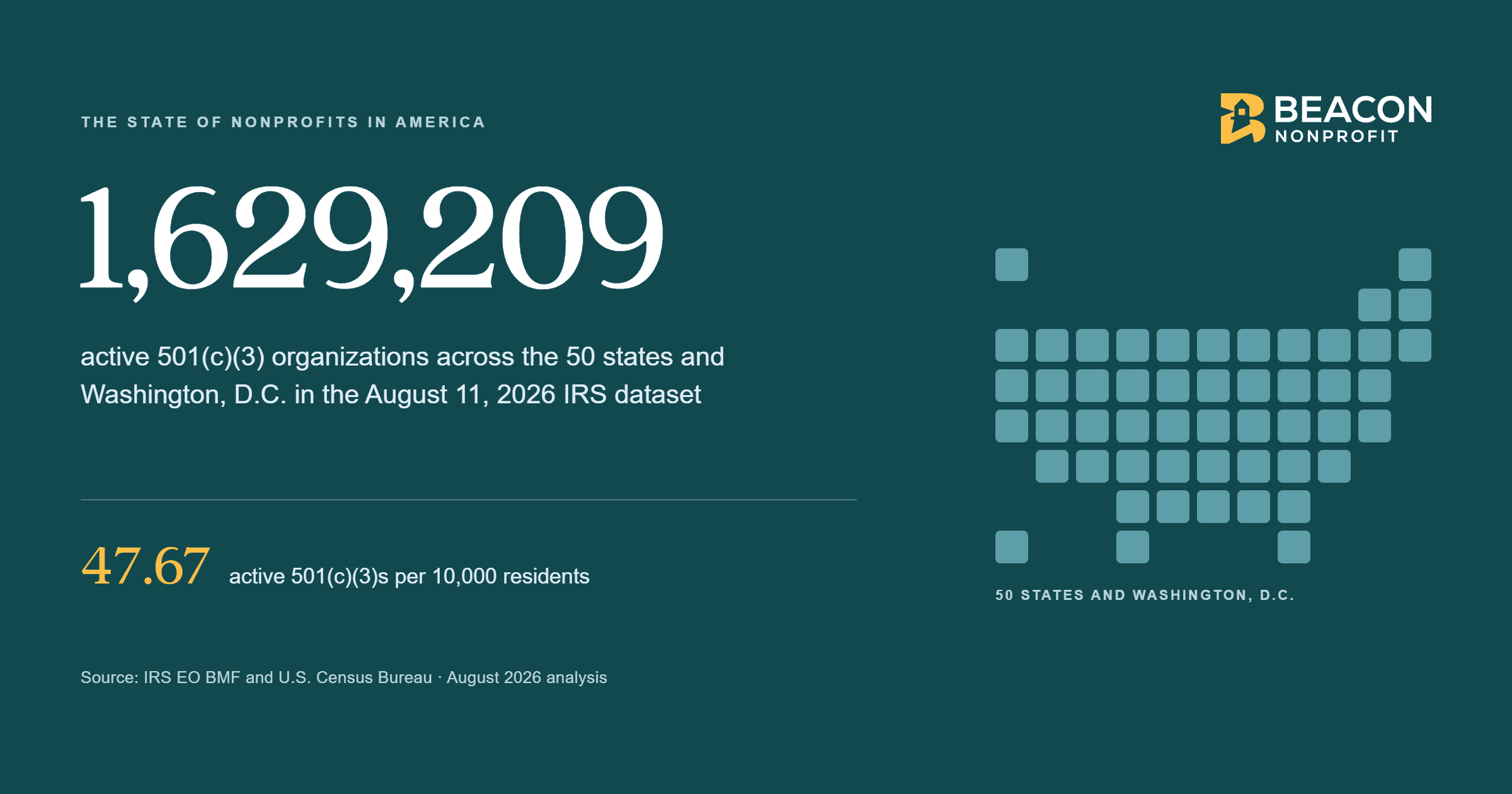
How does the nonprofit sector differ from state to state? This analysis of IRS and U.S. Census data compares active 501(c)(3) organizations by state, population, mission area, and IRS recognition date.

Why Nonprofits Lose Tax-Exempt Status
Tax-exempt status is one of the most valuable things a nonprofit can have, but it can be revoked if your organization isn't careful about compliance. This guide explains the most common reasons nonprofits lose their 501(c)(3) status, what warning signs to watch for, and what to do if it happens to your organization.

How to Reinstate a Revoked Nonprofit
If your nonprofit's tax-exempt status has been revoked, it can feel like a major setback, but the path forward is clearer than you might think. This guide walks you through exactly what revocation means, why it happens, and the steps you need to take to reinstate your organization at both the federal and state level.

Annual Nonprofit Filings Explained: IRS & State Requirements
Annual nonprofit filings are a routine part of staying in good standing with the IRS and the state. This guide explains what nonprofits are expected to file each year, how federal and state requirements work together, and how founders can approach compliance with clarity and confidence.

Nonprofit Filing Deadlines Every Founder Should Know
Nonprofit founders have a lot to keep track of, and filing deadlines are among the most important. This guide breaks down the key dates, forms, and rules you need to know to keep your organization in good standing with the IRS and your state.

Nonprofit Compliance Checklist: What Every Founder Needs to Know
Stay organized with this nonprofit compliance checklist covering annual IRS filings, state requirements, board responsibilities, recordkeeping, and key deadlines.

How to Form a Nonprofit Organization in 8 Steps
Learn how to start a nonprofit organization in eight steps, from state incorporation and board setup to applying for 501(c)(3) tax-exempt status.
The Health and Growth of the U.S. Nonprofit Sector
IRS data reveals a U.S. nonprofit sector of more than 1.6 million active 501(c)(3) organizations, and a third of them received federal recognition since 2020. Here's what the numbers show about sector size, composition, and long-term sustainability.
Tax-Exempt Organization Classifications: What the IRS Data Shows
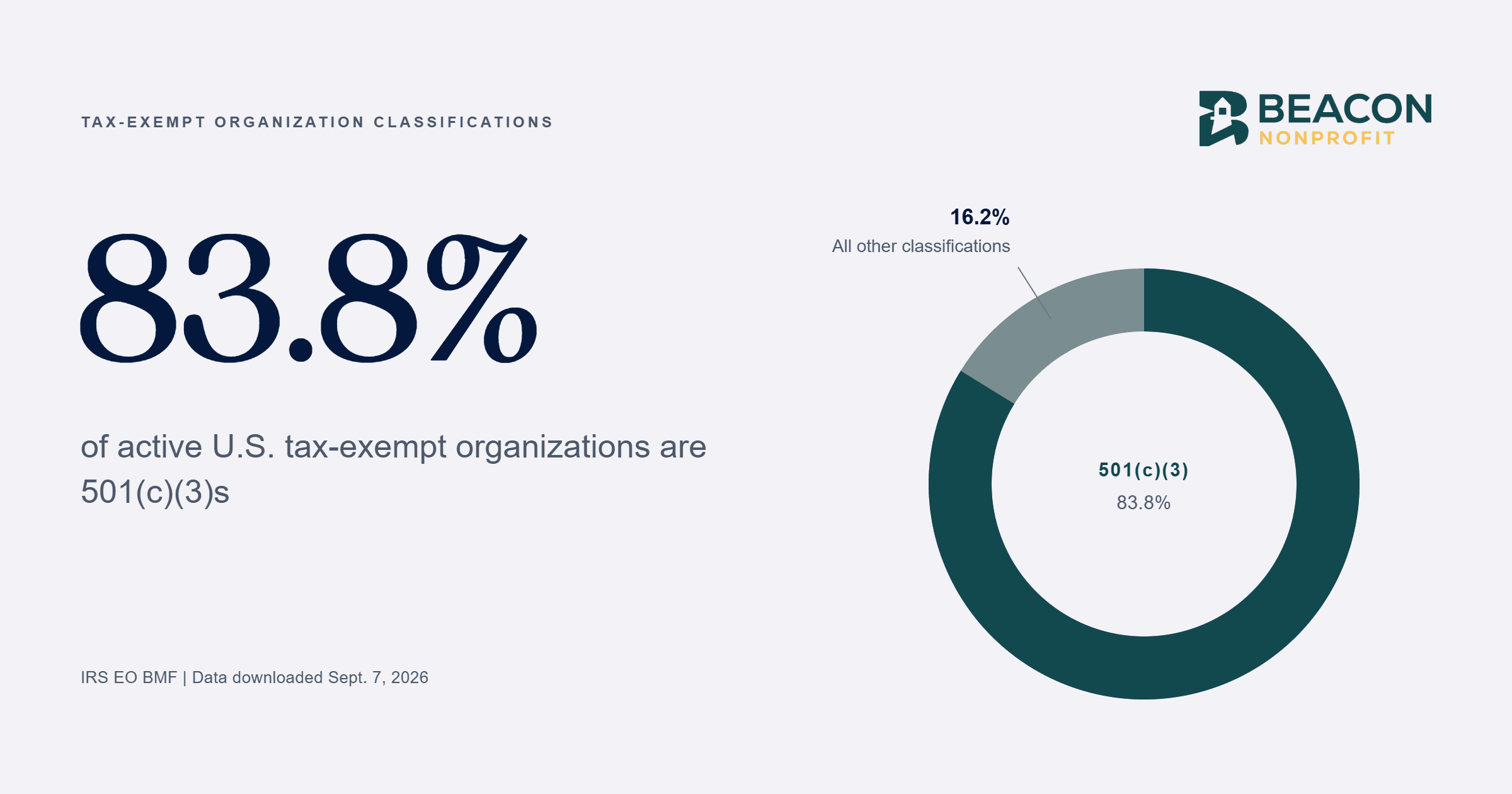
According to Beacon Nonprofit's analysis of IRS Exempt Organizations Business Master File data, 501(c)(3) organizations account for 83.8% of all active tax-exempt organizations in the United States. This article breaks down how the major classifications compare, what the data shows, and how to think about classification when starting a nonprofit.
Get Nonprofit Tips and Compliance Guidance
Subscribe for updates, insights, and resources that help you stay compliant and grow your mission.