Where Active 501(c)(3)s Have Recent IRS Ruling Dates: A State-by-State Analysis

Key Takeaways
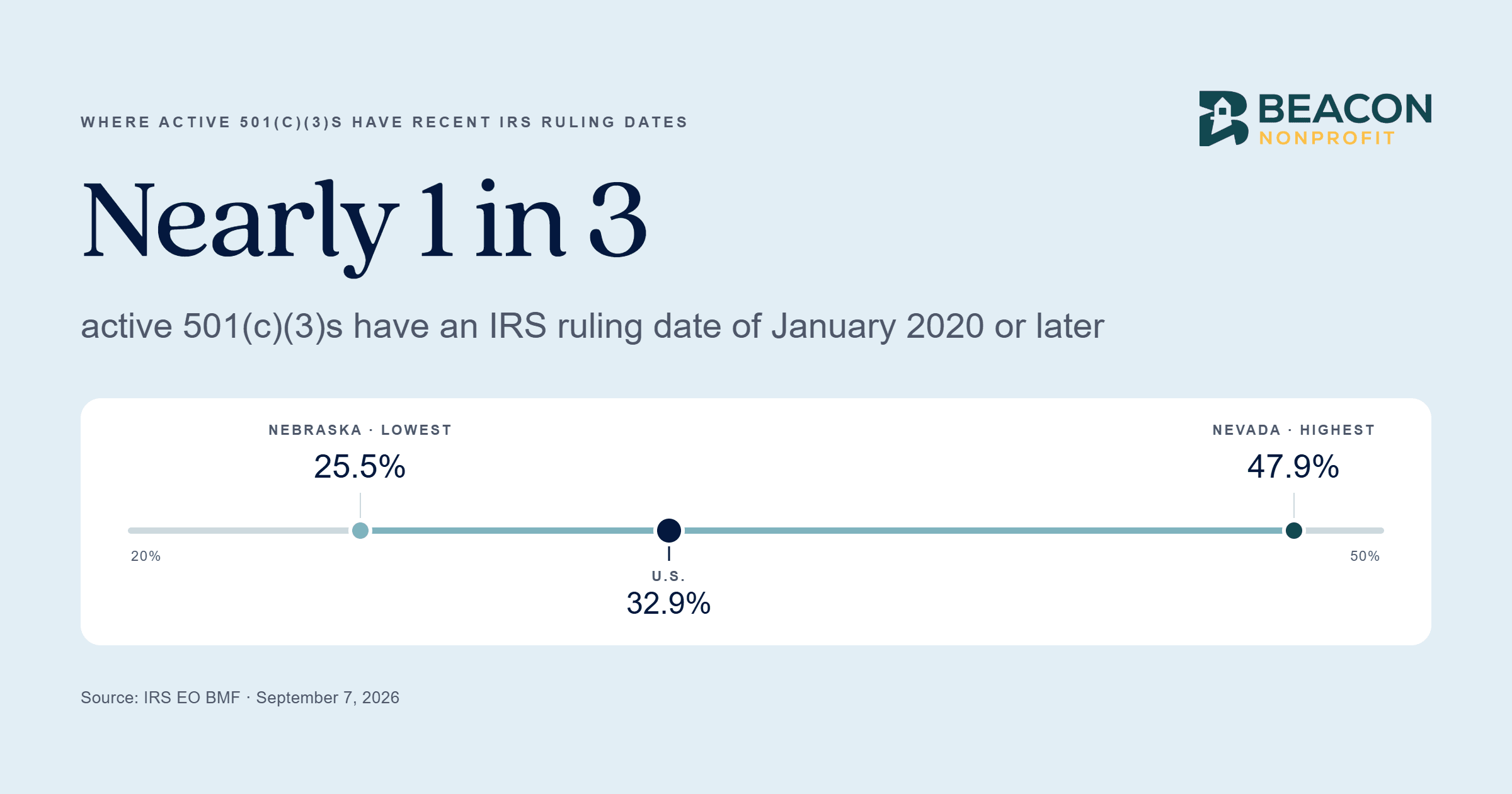
As of September 8, 2026, 32.9% of active 501(c)(3)s in the IRS BMF, about 1 in 3, have a ruling date of January 2020 or later.
The IRS ruling date is when the IRS recognized an organization's tax-exempt status. It is not the date the organization was incorporated or began operations.
The share of recently recognized active 501(c)(3)s ranges from 47.9% in Nevada to 25.5% in Nebraska, a spread of 22.4 percentage points.
The annual ruling date counts in this dataset reflect only organizations still active as of the snapshot date. They do not represent all recognitions the IRS issued in those years.
Staying current on annual IRS filings, such as Form 990, is one of the most important steps to maintaining your organization's recognized status.
Nearly 1 in 3 active 501(c)(3) organizations in the U.S. have an IRS ruling date of January 2020 or later. Beacon Nonprofit's analysis of the IRS Exempt Organizations Business Master File reveals how that share varies across all 50 states and Washington, D.C.
As of September 8, 2026, about 1 in 3 active 501(c)(3) organizations in the United States carry an IRS ruling date of January 2020 or later. That share, 32.9% of the 1,636,144 organizations in Beacon Nonprofit's analysis of the IRS Exempt Organizations Business Master File, tells us something meaningful about the composition of America's active nonprofit sector. It also varies quite a bit from state to state.
The ruling date is the date the IRS formally recognized an organization's tax-exempt status under 501(c)(3). It is not the date the organization was incorporated or the date it began its work. To understand how different types of nonprofit organizations are structured and recognized, the Types of Nonprofit Structures Explained guide is a good place to start.
This article presents the full state-by-state breakdown along with national totals and annual ruling-date counts, drawn from Beacon Nonprofit's analysis of IRS data.
What Share of Active 501(c)(3)s Have a Recent IRS Ruling Date?
Quick Answer
As of September 8, 2026, 32.9% of active 501(c)(3) organizations in the IRS Exempt Organizations Business Master File, about 1 in 3, have an IRS ruling date of January 2020 or later. That share ranges from 47.9% in Nevada to 25.5% in Nebraska. The ruling date reflects when the IRS recognized an organization's tax-exempt status, not when it was formed or incorporated.
What the IRS Data File Measures
The IRS Exempt Organizations Business Master File is a publicly available dataset that lists organizations the IRS currently recognizes as tax-exempt. It is updated on a rolling basis. The organizations in this dataset are active, meaning they have not lost, surrendered, or had their recognition revoked.
The ruling date in the BMF is the date the IRS issued its determination letter recognizing an organization's 501(c)(3) status. As IRS Publication 557 explains, this recognition is a formal step in the tax-exemption process. It is separate from the date an organization was incorporated under state law or the date it first began operations. An organization can exist for months or years before receiving its IRS ruling date.
If you are working through the process of applying for 501(c)(3) status, the ruling date is what you will receive once the IRS approves your application. It is not a retroactive formation date.
This dataset is a single point-in-time snapshot. Organizations that were recognized in earlier years but are no longer active would not appear. That distinction matters when reading the data, especially for older years.
Active 501(c)(3)s With Recent IRS Ruling Dates
Beacon Nonprofit analyzed the three regional EO BMF files as downloaded on September 8, 2026. The population includes active 501(c)(3) organizations in all 50 U.S. states and Washington, D.C. (IRS subsection code 03; status codes 01 and 02).
Figures in this article are drawn from the IRS Exempt Organizations Business Master File, a publicly available dataset. Beacon Nonprofit analyzed the three regional EO BMF files as downloaded on September 8, 2026.
- Total active 501(c)(3)s in the snapshot: 1,636,144
- With a ruling date of January 2020 or later: 538,645 (32.9%)
- With a ruling date before January 2020: 1,094,200 (66.9%, or about two-thirds of the total)
- Records with a missing or invalid ruling date: 3,299 (0.2%). These are included in the total population count but are not counted in the ruling date figures.
For broader context on the active nonprofit population in America, Beacon Nonprofit's companion pieces cover additional dimensions of this dataset: The State of Nonprofits in America looks at sector size and concentration, The Health and Growth of the U.S. Nonprofit Sector: What the IRS Data Shows examines size, composition, and compliance trends together, Tax-Exempt Organization Classifications: What the IRS Data Shows breaks down how the IRS classifies all tax-exempt organizations, and Automatic 501(c)(3) Revocations in America: IRS Data by State examines the landscape of nonprofit status changes.
IRS Ruling Dates by State
The share of active 501(c)(3)s with a ruling date of January 2020 or later ranges from 47.9% in Nevada to 25.5% in Nebraska, a spread of 22.4 percentage points. The table below shows the full picture for all 50 states and Washington, D.C.
Nevada has the highest share of any state: 47.9% of its active 501(c)(3)s carry a ruling date of January 2020 or later. Delaware is second at 45.5%, followed by Utah at 41.8%, Georgia at 39.6%, and Arizona at 39.2%.
Nebraska has the lowest share at 25.5%, followed by Maine (25.7%), Vermont (25.9%), Montana (26.4%), and Alaska (26.7%).
The four largest states by total count are California (177,324), Texas (132,902), New York (106,585), and Florida (102,780). Together they account for roughly 32% of all active 501(c)(3)s in the dataset.
This article does not speculate on why any particular state ranks as it does. The data reflects what the IRS BMF shows as of the snapshot date.
| State | Total Active 501(c)(3)s | Ruling Date Jan 2020 or Later | Share |
|---|---|---|---|
| AK | 4,720 | 1,258 | 26.7% |
| AL | 22,066 | 7,404 | 33.6% |
| AR | 13,518 | 4,460 | 33.0% |
| AZ | 27,598 | 10,824 | 39.2% |
| CA | 177,324 | 61,894 | 34.9% |
| CO | 31,020 | 10,358 | 33.4% |
| CT | 19,251 | 5,549 | 28.8% |
| DC | 10,907 | 3,193 | 29.3% |
| DE | 9,195 | 4,180 | 45.5% |
| FL | 102,780 | 38,985 | 37.9% |
| GA | 55,895 | 22,157 | 39.6% |
| HI | 8,413 | 2,900 | 34.5% |
| IA | 18,195 | 5,051 | 27.8% |
| ID | 8,548 | 3,187 | 37.3% |
| IL | 58,463 | 17,794 | 30.4% |
| IN | 34,686 | 10,643 | 30.7% |
| KS | 14,679 | 4,014 | 27.3% |
| KY | 18,277 | 5,808 | 31.8% |
| LA | 19,316 | 6,988 | 36.2% |
| MA | 37,245 | 11,422 | 30.7% |
| MD | 37,146 | 12,888 | 34.7% |
| ME | 8,104 | 2,080 | 25.7% |
| MI | 46,402 | 14,415 | 31.1% |
| MN | 32,116 | 8,928 | 27.8% |
| MO | 35,038 | 9,509 | 27.1% |
| MS | 12,775 | 4,050 | 31.7% |
| MT | 9,795 | 2,585 | 26.4% |
| NC | 51,553 | 18,748 | 36.4% |
| ND | 5,023 | 1,498 | 29.8% |
| NE | 11,164 | 2,850 | 25.5% |
| NH | 7,608 | 2,059 | 27.1% |
| NJ | 45,383 | 15,394 | 33.9% |
| NM | 9,347 | 2,609 | 27.9% |
| NV | 11,825 | 5,665 | 47.9% |
| NY | 106,585 | 30,713 | 28.8% |
| OH | 60,992 | 17,780 | 29.2% |
| OK | 18,863 | 5,645 | 29.9% |
| OR | 22,347 | 6,870 | 30.7% |
| PA | 65,021 | 18,980 | 29.2% |
| RI | 5,355 | 1,573 | 29.4% |
| SC | 28,529 | 8,387 | 29.4% |
| SD | 5,447 | 1,604 | 29.4% |
| TN | 33,299 | 10,776 | 32.4% |
| TX | 132,902 | 49,142 | 37.0% |
| UT | 11,324 | 4,738 | 41.8% |
| VA | 45,129 | 15,694 | 34.8% |
| VT | 5,267 | 1,362 | 25.9% |
| WA | 35,347 | 11,199 | 31.7% |
| WI | 30,561 | 8,291 | 27.1% |
| WV | 9,148 | 2,715 | 29.7% |
| WY | 4,928 | 1,829 | 37.1% |
You can verify the current recognized status of any organization using the IRS Tax Exempt Organization Search.
Annual IRS Ruling Date Counts
The table below shows how many active 501(c)(3)s in the September 8, 2026 BMF snapshot carry a ruling date in each year from 2000 through 2025.
Important note: These figures reflect only organizations that were still active as of September 8, 2026. They do not represent a count of all 501(c)(3) recognitions the IRS issued in those years. Organizations recognized in earlier years that are no longer active, whether due to revocation, dissolution, or other reasons, would not appear in this dataset. As a result, older years are likely understated compared to more recent ones. Do not read these figures as a measure of how many nonprofits were recognized, formed, or started in any given year.
| Year | Count |
|---|---|
| 2000 | 19,507 |
| 2001 | 21,436 |
| 2002 | 22,156 |
| 2003 | 20,194 |
| 2004 | 21,879 |
| 2005 | 24,700 |
| 2006 | 21,191 |
| 2007 | 22,744 |
| 2008 | 21,037 |
| 2009 | 25,353 |
| 2010 | 23,247 |
| 2011 | 24,918 |
| 2012 | 23,099 |
| 2013 | 31,175 |
| 2014 | 63,307 |
| 2015 | 42,892 |
| 2016 | 42,859 |
| 2017 | 42,544 |
| 2018 | 43,770 |
| 2019 | 53,488 |
| 2020 | 45,663 |
| 2021 | 51,217 |
| 2022 | 73,570 |
| 2023 | 73,113 |
| 2024 | 102,482 |
| 2025 | 112,733 |
One figure stands out in the raw data: the 2014 count of 63,307 is roughly double the years immediately before and after it. This appears in the IRS data as provided. This article does not speculate on the cause.
The IRS provides guidance on applying for tax-exempt status that covers what happens during the review process, including how ruling dates are assigned. Once an organization receives its ruling date, it also takes on ongoing filing obligations. When Your Nonprofit Must File 990-N, 990-EZ, or 990 explains which annual return applies to your organization based on its size. Keeping up with those filings is one of the most important ways to protect your recognized status. To understand what can happen when filings lapse, Why Nonprofits Lose Tax-Exempt Status is worth reading.
What This IRS Data Means for Your Nonprofit
The IRS BMF snapshot offers a useful, factual look at the active nonprofit sector. It shows that a significant share of currently recognized 501(c)(3)s received their IRS ruling date within the past several years, and that this share varies across states.
What it does not tell us is why any state ranks where it does, how many nonprofits applied and were not approved, or how many organizations existed but are no longer active. The data has real limits, and understanding those limits is part of reading it clearly.
If you are in the process of forming a nonprofit, How to Form a Nonprofit Organization in 8 Steps walks through each stage from incorporation to IRS recognition. Once your organization is recognized, staying compliant is what keeps it in good standing. The Nonprofit Compliance Checklist: What Every Founder Needs to Know is a practical resource for understanding what your organization is responsible for, year after year.
Beacon Nonprofit is here to help founders move through this process with clarity and confidence, from your first filing to long-term compliance.
Frequently Asked Questions
The IRS ruling date is the date the IRS formally recognized your organization's 501(c)(3) tax-exempt status. It appears in your IRS determination letter and in the IRS Exempt Organizations Business Master File. It is not the same as the date your nonprofit was incorporated or when it first began operating.
The EO BMF is a publicly available dataset published by the IRS that lists organizations currently recognized as tax-exempt. It is updated continuously and includes the ruling date, subsection code, and status for each organization.
It means the IRS formally recognized your organization's 501(c)(3) status recently. Many active nonprofits received their recognition within the past few years. A recent ruling date does not indicate anything unusual about your organization.
You can use the IRS Tax Exempt Organization Search to look up your organization's current status, ruling date, and filing history. This tool is free and publicly accessible.
The counts in this dataset reflect only organizations that were still active as of the September 8, 2026, snapshot. Organizations recognized in earlier years that are no longer active would not appear, so older years tend to be understated. The figures should not be read as a count of all recognitions the IRS issued in any given year.
Related Articles

Types of Nonprofit Structures Explained
Your legal structure shapes everything from how your board operates to how you apply for tax-exempt status. Learn the main nonprofit structures, what makes them different, and how to choose the right one for your mission.

How to Apply for 501(c)(3) Tax-Exempt Status
Applying for 501(c)(3) tax-exempt status allows nonprofit organizations to receive tax-deductible donations and operate as federally recognized charities. This guide explains the steps required to apply, including forming a nonprofit corporation, obtaining an EIN, preparing governance documents, and submitting IRS Form 1023 or Form 1023-EZ.
The State of Nonprofits in America: A State-by-State Analysis
How does the nonprofit sector differ from state to state? This analysis of IRS and U.S. Census data compares active 501(c)(3) organizations by state, population, mission area, and IRS recognition date.
Automatic 501(c)(3) Revocations in America: IRS Data by State
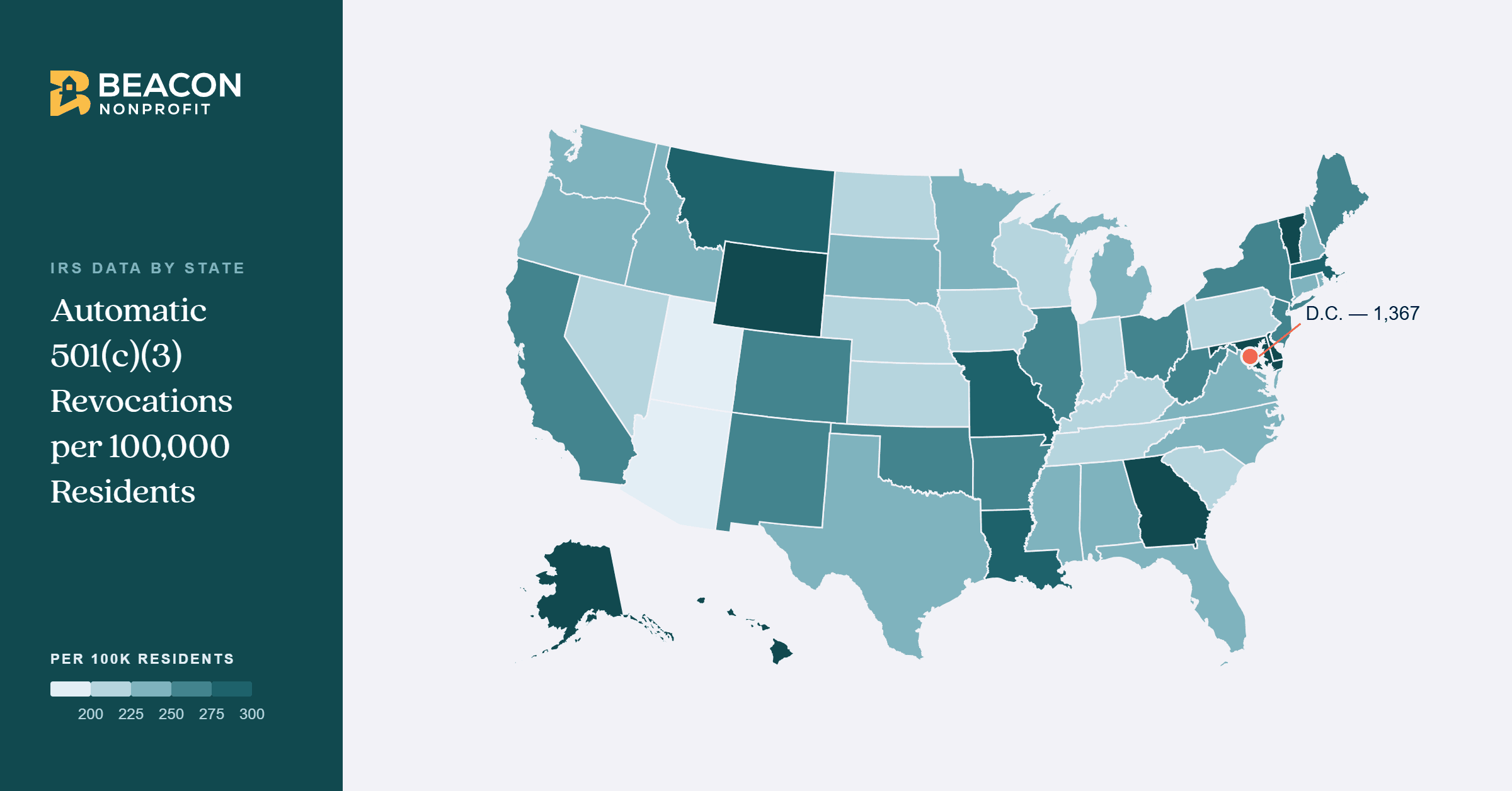
See how automatic 501(c)(3) revocations vary across the United States, including state-by-state rates, historical trends, and what nonprofits need to know about maintaining tax-exempt status.

When Your Nonprofit Must File 990-N, 990-EZ, or 990
Not every nonprofit files the same tax return, and knowing which Form 990 your organization is required to submit can save you from costly mistakes. This guide breaks down the differences between 990-N, 990-EZ, and the full Form 990, so you always know where your nonprofit stands.

Why Nonprofits Lose Tax-Exempt Status
Tax-exempt status is one of the most valuable things a nonprofit can have, but it can be revoked if your organization isn't careful about compliance. This guide explains the most common reasons nonprofits lose their 501(c)(3) status, what warning signs to watch for, and what to do if it happens to your organization.

How to Form a Nonprofit Organization in 8 Steps
Learn how to start a nonprofit organization in eight steps, from state incorporation and board setup to applying for 501(c)(3) tax-exempt status.

Nonprofit Compliance Checklist: What Every Founder Needs to Know
Stay organized with this nonprofit compliance checklist covering annual IRS filings, state requirements, board responsibilities, recordkeeping, and key deadlines.
The Health and Growth of the U.S. Nonprofit Sector
IRS data reveals a U.S. nonprofit sector of more than 1.6 million active 501(c)(3) organizations, and a third of them received federal recognition since 2020. Here's what the numbers show about sector size, composition, and long-term sustainability.
Tax-Exempt Organization Classifications: What the IRS Data Shows
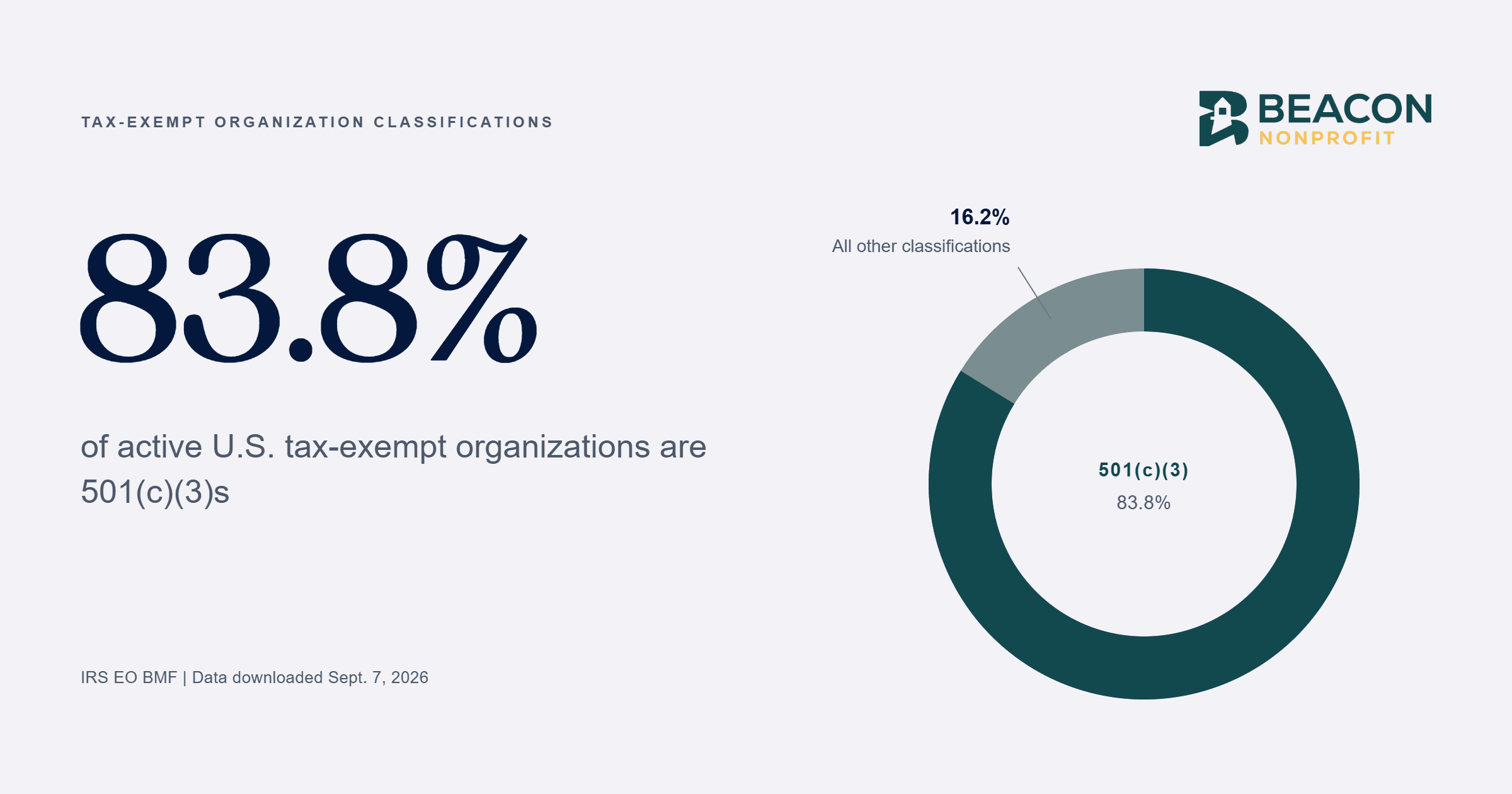
According to Beacon Nonprofit's analysis of IRS Exempt Organizations Business Master File data, 501(c)(3) organizations account for 83.8% of all active tax-exempt organizations in the United States. This article breaks down how the major classifications compare, what the data shows, and how to think about classification when starting a nonprofit.
Get Nonprofit Tips and Compliance Guidance
Subscribe for updates, insights, and resources that help you stay compliant and grow your mission.