How to Start an Educational Nonprofit Organization


Key Takeaways
Educational nonprofits can provide tutoring, scholarships, literacy programs, job training, and other learning opportunities.
Most educational nonprofits form a nonprofit corporation at the state level before applying for federal 501(c)(3) tax-exempt status.
Starting an educational nonprofit involves defining your mission, planning your programs, incorporating, obtaining an EIN, and addressing applicable tax-exempt status and state requirements.
Organizations operating schools or other regulated educational programs may need additional state licenses or approvals and must meet specific IRS requirements.
Maintaining a nonprofit involves ongoing IRS filings, state compliance, accurate financial records, and responsible governance.
Learn how to start an educational nonprofit organization, from defining your mission and incorporating to applying for 501(c)(3) status and meeting ongoing requirements.
Education can change lives, but not everyone has access to the resources and opportunities they need to learn. Starting an educational nonprofit can help address those gaps, whether your goal is to provide tutoring, offer scholarships, teach job skills, or support underserved students.
Before you can begin serving your community, you'll need to establish your organization and understand the legal requirements involved.
The process is similar to starting a nonprofit organization, with a few additional considerations depending on the educational programs you plan to offer.
This guide walks you through the steps to start an educational nonprofit, apply for federal tax-exempt status, and prepare your organization for long-term operations.
What Is an Educational Nonprofit Organization?
An educational nonprofit organization is created to provide learning opportunities, instruction, or educational resources that serve a qualifying exempt purpose. Educational nonprofits may offer tutoring, scholarships, workforce training, literacy programs, or other services that benefit individuals and communities.
Under IRS guidance on educational purposes, educational activities generally include teaching or training individuals to develop their abilities or educating the public about subjects that benefit the community.
Educational nonprofits can take many forms, including:
- Tutoring programs: Providing academic support to students who need additional help.
- Scholarship organizations: Helping eligible students access educational opportunities.
- Literacy programs: Teaching reading, writing, and other essential skills.
- Workforce development programs: Offering job training and career preparation.
- Community education programs: Providing classes, workshops, and learning resources.
- Nonprofit schools: Operating educational institutions that meet applicable state and federal requirements.
Not every educational nonprofit operates a school. A community tutoring program, for example, may qualify as an educational organization without meeting the IRS definition of a school.
Many educational nonprofits seek recognition under Section 501(c)(3) of the Internal Revenue Code. However, incorporating as a nonprofit does not automatically grant federal tax-exempt status.
How Do You Start an Educational Nonprofit Organization?
Quick Answer
To start an educational nonprofit organization, define your educational mission, plan your programs, choose a nonprofit structure, and incorporate in your state. Next, obtain an Employer Identification Number (EIN), apply for federal 501(c)(3) tax-exempt status if eligible, and complete any required state registrations or educational approvals. Specific requirements depend on your organization's activities and location.
Step 1: Define Your Mission and Vision
Before filing paperwork, decide what educational need your nonprofit will address and who it will serve.
Will you help children improve their reading skills? Provide scholarships to students from low-income families? Offer job training to adults entering the workforce?
Your mission should explain what your organization does, who benefits, and how your programs will make a difference.
For example, an educational nonprofit might have this mission:
To expand educational opportunities for underserved students by providing free tutoring, mentoring, and academic resources.
A clear mission helps guide your programs, fundraising efforts, and decisions as your organization grows.
If you're still developing your purpose, our guide to nonprofit mission, purpose, and vision statements can help you get started.
Step 2: Plan Your Educational Programs
Once you've defined your mission, decide how your nonprofit will deliver its services.
An educational nonprofit needs more than a general goal of helping people learn. You'll want to explain what programs you plan to offer, how they will work, and who will benefit.
Consider questions such as:
- Who will participate? Children, college students, adults, or the general public?
- What will you teach? Academic subjects, literacy, job skills, or another area?
- How will programs operate? In person, online, or through community partnerships?
- Who will provide instruction? Employees, educators, contractors, or volunteers?
- How will you fund the programs? Donations, grants, program fees, or other sources?
For example, a nonprofit focused on reading support might offer free after-school tutoring, distribute books, and partner with local schools to reach students.
Educational nonprofits can also support students in other ways. If your goal is to help students pay for school or other educational opportunities, our guide to starting a scholarship fund explains your options, including forming a nonprofit or working with a fiscal sponsor.
If you're interested in supporting school programs, student activities, or extracurricular opportunities, you can also explore how to start a booster club.
Developing your programs early also helps when applying for 501(c)(3) status. The IRS may review your planned activities to determine whether your organization meets the requirements for an educational tax-exempt purpose.
Step 3: Choose Your Nonprofit Structure
Most educational nonprofits form as nonprofit corporations under state law.
A nonprofit corporation is a separate legal entity that can hold assets, enter contracts, and operate programs in its own name. Incorporation also generally provides some separation between the organization's obligations and the personal assets of its founders and board members, although liability protection is not absolute.
After incorporating, many educational nonprofits apply for federal tax-exempt status under Section 501(c)(3).
Organizations recognized under this section generally qualify for federal income tax exemption on income related to their exempt purposes. Contributions to qualifying organizations may also be tax-deductible, subject to applicable rules.
Educational nonprofits must operate for qualifying exempt purposes rather than the private benefit of founders or other individuals.
You can learn more about available classifications in our guide to types of nonprofit structures.
Step 4: Form Your Educational Nonprofit Corporation
Nonprofit incorporation takes place at the state level. Although requirements vary, you'll generally need to complete several steps.
1. Choose Your Nonprofit's Name
Select a name that reflects your educational mission and meets your state's naming requirements. Search your state's business registry to check availability.
2. Appoint a Registered Agent
Your Registered Agent receives official legal documents and certain government notices on behalf of your nonprofit.
3. File Articles of Incorporation
Submit your Articles of Incorporation to the appropriate state agency, often the Secretary of State.
If you plan to seek 501(c)(3) status, your organizing document must satisfy IRS requirements, including appropriate provisions limiting the organization's purposes and dedicating its assets to qualifying purposes if it dissolves. Certain state laws may satisfy the dissolution requirement.
4. Create Your Nonprofit Bylaws
Bylaws establish how your nonprofit operates, including board responsibilities, meetings, voting, and decision-making procedures.
You can use our nonprofit bylaws template to understand what to include.
5. Establish Your Board of Directors
Your board provides oversight and helps ensure that the organization operates in support of its mission. The number of directors required depends on state law and your organizational structure.
Taking these steps establishes your nonprofit corporation at the state level. Federal tax-exempt recognition is a separate process for organizations required to apply.
Ready to Form Your Nonprofit?
Wherever you are in the planning process, Beacon Nonprofit can help you navigate the steps to form your organization with clear guidance and support.
Form Your NonprofitStep 5: Apply for an Employer Identification Number (EIN)
An Employer Identification Number, or EIN, is a federal tax identification number issued by the IRS.
Your educational nonprofit generally needs an EIN to open an organizational bank account, file tax documents, and apply for 501(c)(3) recognition.
You can apply for an EIN directly through the IRS at no cost.
An EIN does not mean your educational nonprofit has been approved for tax-exempt status. It simply identifies your organization for federal tax purposes.
Beacon Nonprofit also offers EIN preparation and submission assistance as part of applicable formation services.
Step 6: Apply for 501(c)(3) Tax-Exempt Status
Many educational nonprofits seek 501(c)(3) recognition to support fundraising and operate as federally tax-exempt organizations.
To apply, organizations generally submit either Form 1023 or Form 1023-EZ to the IRS, depending on eligibility.
IRS Form 1023 is the standard application and requires detailed information about your organization's purpose, programs, governance, and finances.
IRS Form 1023-EZ is a shorter application available only to organizations that meet the IRS eligibility requirements.
Importantly, organizations that meet the IRS definition of a school, college, or university are not eligible to use Form 1023-EZ.
A tutoring program or community education organization that does not meet the IRS definition of a school may be eligible for Form 1023-EZ if it satisfies all other requirements.
The IRS may review information such as:
- Your educational purpose and planned activities.
- How participants are selected and served.
- Your organization's leadership and financial structure.
- Whether your programs serve qualifying exempt purposes.
- Whether your organization avoids prohibited private benefit and private inurement.
Organizations providing scholarships or grants to individuals may need to explain their selection criteria and how awards will be administered.
Learn more about eligibility in our guide to Form 1023 vs. Form 1023-EZ.
IRS processing times vary based on the application and whether additional information is needed.
If an eligible organization files its exemption application within 27 months after the end of the month it was legally formed, IRS recognition is generally effective from its formation date, assuming applicable requirements are met. Different rules may apply to later applications.
If you're ready for this step, Beacon Nonprofit's 501(c)(3) application service can help you prepare and submit your application.
Step 7: Complete State Registrations and Educational Requirements
Depending on your programs, your educational nonprofit may need additional registrations or approvals before operating.
Charitable Solicitation Registration
Many states require nonprofit organizations to register before soliciting charitable contributions unless an exemption applies.
This requirement is separate from incorporating your nonprofit and obtaining federal tax-exempt status.
If your organization plans to raise funds, review the rules in each state where registration may be required.
Our guide to charitable solicitation registration explains these responsibilities.
Educational Licensing and Approval
If your nonprofit plans to operate a school, preschool, vocational training institution, or other regulated educational program, state licensing or approval requirements may apply.
Requirements can depend on the type of education offered, students' ages, and whether the organization grants credentials or degrees.
Programs serving children may also be subject to background checks, health, safety, and child protection requirements.
Federal 501(c)(3) recognition does not replace these state requirements.
Do Educational Nonprofits Need Accreditation?
Not every educational nonprofit needs accreditation.
Organizations providing tutoring, community workshops, literacy instruction, or informal training may operate without educational accreditation, depending on state law and their activities.
Schools, colleges, and certain career training programs may face different licensing, approval, or accreditation requirements.
Accreditation and state authorization are not the same thing. Accreditation generally involves evaluation by an accrediting organization, while state authorization addresses legal permission to operate certain educational institutions or programs.
Before opening a school or offering formal academic credentials, check with your state's education agency or other applicable regulator.
How Do Educational Nonprofits Get Funding?
Educational nonprofits may receive funding through several sources, including individual donations, grants, corporate sponsorships, fundraising events, and program fees.
The right approach depends on your programs, the community you serve, and your organization's eligibility for different funding opportunities.
For example, a tutoring nonprofit might seek donations from local businesses, while a scholarship organization might establish a fund supported by individual donors.
Some grantmakers require proof of 501(c)(3) status or other eligibility documents before awarding funding.
Creating a clear program budget and explaining how donations will support educational activities can help you prepare for fundraising.
For a broader look at your options, explore our guide to how nonprofits get funding.
What Comes After Starting an Educational Nonprofit?
After forming your organization and obtaining the necessary approvals, you'll need to keep up with ongoing responsibilities.
These may include:
- IRS annual filings: Most tax-exempt organizations must file an annual Form 990-series return or notice, although exceptions apply. Many small educational nonprofits with gross receipts normally $50,000 or less may qualify to file Form 990-N, also called the e-Postcard. Missing required annual IRS filings for three consecutive years results in automatic revocation of federal tax-exempt status.
- State annual reports: File applicable reports to maintain your nonprofit corporation's good standing.
- Charitable registration renewals: Keep required registrations current as your fundraising activities continue.
- Board meetings and records: Follow your bylaws and applicable state requirements, and document important decisions.
- Donation acknowledgments: Provide appropriate records to donors. Donors generally need written acknowledgment from the organization to substantiate an individual charitable contribution of $250 or more.
- Educational program requirements: Maintain any required licenses, approvals, safety procedures, or other standards that apply to your programs.
Educational nonprofits should also maintain accurate financial records and review how their programs support the organization's exempt purpose.
If your nonprofit qualifies for Form 990-N, Beacon's Form 990-N filing service can help you prepare and submit your annual notice to the IRS.
For additional guidance, explore Beacon's Nonprofit Compliance Checklist.
Final Thoughts
Starting an educational nonprofit gives you an opportunity to make learning more accessible and support people in your community.
Whether you want to offer tutoring, provide scholarships, or create new educational programs, the first steps involve defining your mission, building a clear plan, and establishing your organization properly.
Understanding the requirements early can help you focus on developing programs that serve your community. If you're ready to take the next step, our guide on how to form a nonprofit organization explains the formation process in more detail.
Frequently Asked Questions
Yes. Educational purposes are among the qualifying exempt purposes under Section 501(c)(3). An educational nonprofit may qualify if it meets IRS requirements, operates for an exempt purpose, and avoids prohibited private benefit or private inurement. State incorporation alone does not automatically provide federal tax-exempt recognition.
Not necessarily. You generally do not need to be a licensed teacher to form an educational nonprofit corporation. However, certain educational programs, schools, and teaching positions may require professional credentials, state licensing, or other approvals. Requirements depend on your organization's activities and location.
Yes. Educational nonprofits can provide scholarships when the awards serve qualifying charitable or educational purposes. Organizations should establish objective selection criteria, maintain appropriate records, and avoid improper private benefits. Private foundations making grants to individuals may also need IRS-approved grant procedures.
Yes. An educational nonprofit may charge tuition or program fees, provided its activities meet applicable tax-exemption requirements. Charging fees does not automatically disqualify an organization from 501(c)(3) status. However, its programs must serve qualifying exempt purposes rather than improperly benefiting private individuals.
Not always. Tutoring programs, literacy organizations, and community education nonprofits may not need accreditation. Schools, colleges, and certain career training programs can face additional state authorization, licensing, or accreditation requirements. The rules depend on the type of educational services provided and the state where the organization operates.
Some educational nonprofits may qualify for Form 1023-EZ if they meet all IRS eligibility requirements. However, organizations that meet the IRS definition of a school, college, or university generally cannot use Form 1023-EZ and must apply using the full Form 1023.
Most tax-exempt educational nonprofits must file an annual Form 990-series return or notice, although exceptions apply. Eligible smaller organizations with gross receipts normally $50,000 or less may file Form 990-N. Larger organizations generally file Form 990-EZ or Form 990, depending on their finances and classification.
Related Articles

Nonprofit Bylaws Template (With Example)

Nonprofit bylaws are your organization's rulebook. This guide explains what to include in your bylaws, offers a practical template, and helps you get it right the first time.

Form 1023 vs. Form 1023-EZ: What's the Difference?
If you're applying for 501(c)(3) tax-exempt status, the IRS gives you two options: Form 1023 and Form 1023-EZ. Understanding the difference between them, and which one your organization qualifies to use, can save you time, money, and stress.

How to Write a Nonprofit Mission Statement (With Examples)
Your nonprofit's mission statement is more than a sentence on your website. It tells donors, volunteers, the IRS, and your community exactly what you stand for and who you serve. Here's how to write one that's clear, focused, and built to last.

How to Apply for 501(c)(3) Tax-Exempt Status
Applying for 501(c)(3) tax-exempt status allows nonprofit organizations to receive tax-deductible donations and operate as federally recognized charities. This guide explains the steps required to apply, including forming a nonprofit corporation, obtaining an EIN, preparing governance documents, and submitting IRS Form 1023 or Form 1023-EZ.

How to File Form 990-N With Beacon Nonprofit
Learn how to file Form 990-N with Beacon Nonprofit, who qualifies, what information you'll need, and how to meet your annual IRS filing requirement.

Are Donations to Nonprofits Tax-Deductible?
Not all donations to nonprofits are automatically tax-deductible. Learn which organizations qualify, what donors need to claim a deduction, and what nonprofit founders should know to support their donors confidently.
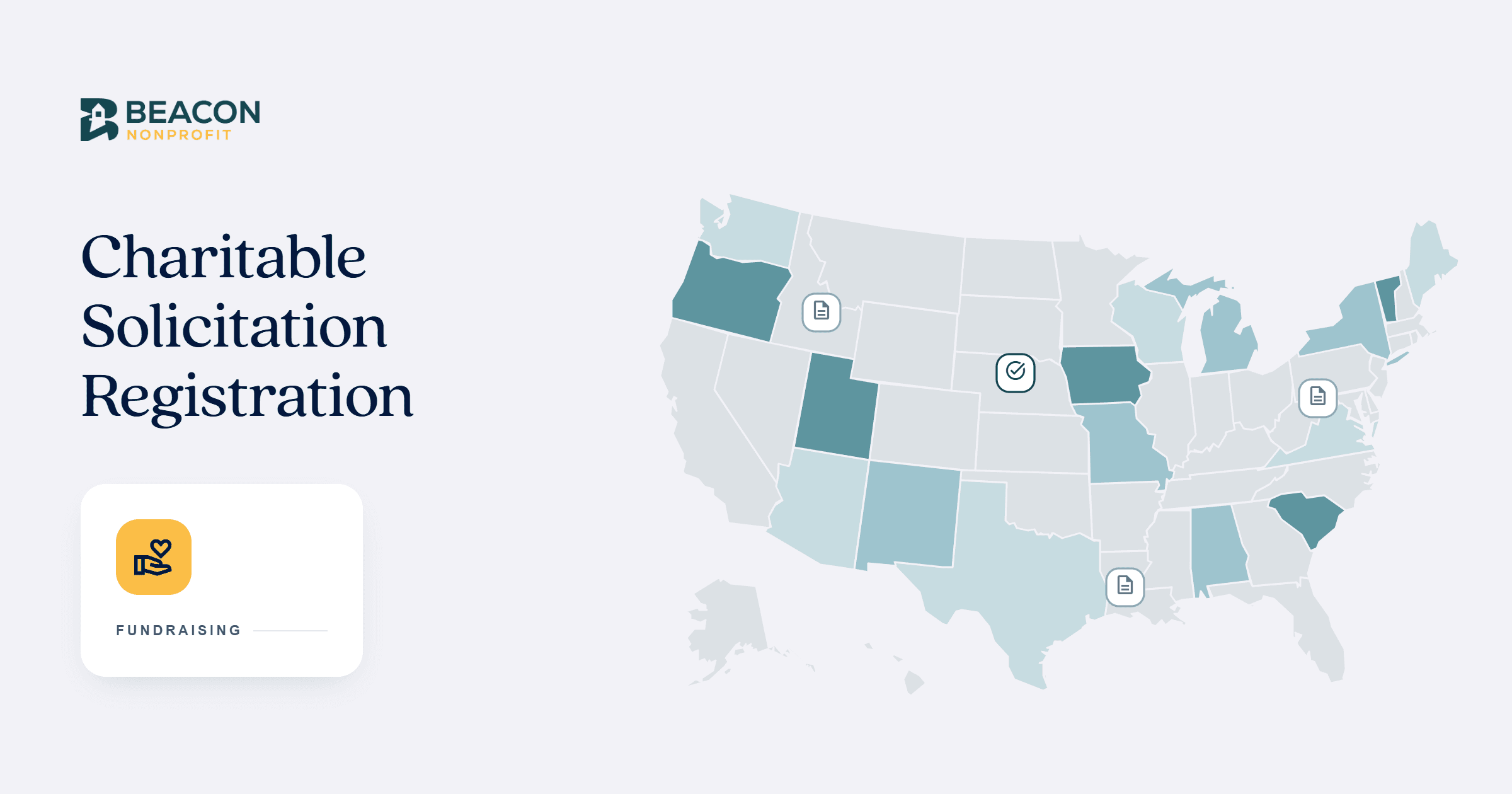
Charitable Solicitation Registration: What Nonprofits Need to Know
Learn what charitable solicitation registration is, when your nonprofit may need to register, and how state fundraising requirements fit into nonprofit compliance.

How Nonprofits Get Funding: Complete Guide for New Founders
Launching a nonprofit takes passion. But sustaining it takes funding. From grants and donations to earned income and sponsorships, understanding where your money can come from is key to building a mission that lasts. This guide from Beacon explains the most common funding sources for new 501(c)(3) founders and how to approach each one with confidence.

How to Form a Nonprofit Organization in 8 Steps
Learn how to start a nonprofit organization in eight steps, from state incorporation and board setup to applying for 501(c)(3) tax-exempt status.

Types of Nonprofit Structures Explained
Your legal structure shapes everything from how your board operates to how you apply for tax-exempt status. Learn the main nonprofit structures, what makes them different, and how to choose the right one for your mission.
Get Nonprofit Tips and Compliance Guidance
Subscribe for updates, insights, and resources that help you stay compliant and grow your mission.