North Carolina Nonprofit Bylaws: Requirements, Contents & Best Practices


Key Takeaways
North Carolina requires the incorporators or initial board of directors to adopt bylaws under N.C. Gen. Stat. § 55A-2-06.
Bylaws are an internal governing document. They are not filed with the North Carolina Secretary of State, but the IRS reviews them when you apply for 501(c)(3) status.
State law allows a single director, but the IRS generally expects at least three unrelated board members before granting tax-exempt status.
Your bylaws must not contradict your Articles of Incorporation. If they conflict, the Articles control.
Core sections to include: purpose, board structure, officer duties, meeting and voting rules, committees, and an amendment process.
A conflict of interest policy, indemnification clause, and record-keeping procedures are not legally mandatory in North Carolina, but the IRS and most funders expect them.
Your Articles of Incorporation give your nonprofit a legal name. Your bylaws are what actually make it run. Here's every clause North Carolina expects you to have, and the ones smart founders add anyway.
Most founders treat bylaws as paperwork to get through before the "real" work starts. Then six months in, a board member resigns mid-term, nobody can agree on how to fill the seat, and someone finally asks to see the bylaws, only to find a one-page template that never addressed the situation.
Bylaws are the document you write for the day things get complicated, not the day everything goes smoothly. Get them right now while you have time to think clearly, so you will not be improvising governance decisions under pressure later.
This guide walks through exactly what North Carolina law requires, what belongs in a well-built set of bylaws, and the clauses experienced founders add before they ever need them.
Are Bylaws Legally Required for a North Carolina Nonprofit?
Yes. Under the North Carolina Nonprofit Corporation Act, § 55A-2-06, the incorporators or the initial board of directors must adopt bylaws for the corporation. The statute gives you wide latitude on content: bylaws may contain any provision for managing the corporation's affairs that does not conflict with state law or your Articles of Incorporation.
Two things follow from that:
- Bylaws are not filed with the state. Unlike your Articles of Incorporation, which are filed with the North Carolina Secretary of State's Business Registration Division, bylaws remain internal. You keep them in your corporate records and produce them on request.
- The IRS reads them closely. When you apply for 501(c)(3) status using Form 1023, your bylaws are part of the submission package. Weak or mis
“Sing governance provisions is a common reason applications get flagged for follow-up questions.
If you have not yet filed your articles, that step comes first. Our full walkthrough, how to start a nonprofit organization in North Carolina in 12 steps, covers naming, filing, and EIN registration in the order you will actually need them.
When Should You Adopt Bylaws?
Bylaws are typically adopted at the organization's first official board meeting, right after your Articles of Incorporation are approved. Waiting longer creates a gap where your board technically exists but has no documented rules for how it operates, which becomes a problem the moment a decision needs a formal vote.
How Many Directors Does North Carolina Require?
State law sets the bar low: one director is legally sufficient to form a nonprofit corporation in North Carolina. In practice, that minimum is almost never the right number to build around.
The IRS generally expects at least three unrelated board members before it will grant 501(c)(3) recognition, since a single-person or family-controlled board raises private benefit and conflict of interest concerns. Most experienced founders aim for five to seven directors from the start. A larger, more independent board:
- Distributes fiduciary responsibility instead of concentrating it in one or two people
- Makes it easier to reach quorum even when a director or two is unavailable
- Signals to funders and grant reviewers that the organization has real oversight, not a rubber-stamp board
What Must Your Bylaws Include?
North Carolina does not hand you a required template, but a complete set of bylaws for a 501(c)(3) applicant needs to address the following.
Name, Purpose, and Principal Office
State your official corporate name exactly as it appears on your Articles of Incorporation, along with your principal office location and a purpose statement. This purpose language should closely track the language in your articles. If your bylaws describe a different mission than your Articles, that mismatch is exactly the kind of inconsistency § 55A-2-06 warns against, and it can slow down an IRS review.
Membership Structure
Decide early whether your nonprofit will have a formal voting membership separate from the board or whether the board is the only governing body. Under North Carolina law, members have no voting rights or other privileges unless those rights are explicitly set forth in the articles or bylaws. If you are not planning a membership structure, say so plainly to avoid ambiguity later.
Board of Directors
This section carries the most operational weight. Define:
- Board size, ideally as a range (for example, five to eleven directors) rather than a fixed number, so a single resignation does not force a bylaws amendment
- Qualifications for serving as a director
- Term length and term limits
- The election and removal process
- How and when meetings are called, including notice requirements
- Quorum, meaning the minimum number of directors who must be present for a vote to count
Officers
List the required officer titles, typically President or Chair, Vice President, Secretary, and Treasurer, and spell out each role's duties. Vague officer descriptions are one of the more common sources of internal disputes once a nonprofit has real assets and real decisions to make.
Committees
If your board plans to use an executive committee, finance committee, or other standing committees, define their powers and how they are formed. Committees exercising board-level authority should have limits spelled out here, not decided informally after the fact.
Meeting and Voting Rules
Cover regular meeting frequency, how emergency meetings are called, notice periods, and the voting threshold needed to pass routine versus major decisions. This is also where you can build in flexibility for remote or electronic participation, as permitted under Chapter 55A.
Amendment Procedures
Specify who can propose changes to the bylaws, what notice is required, and what vote threshold passes an amendment. Without this clause, your board has no documented way to update its own governing rules.
Best Practices Beyond the Legal Minimum
North Carolina's statute is intentionally broad. The clauses below are not required by § 55A-2-06, but they are what separates bylaws that hold up under scrutiny from ones that leave your board exposed.
Adopt a Conflict of Interest Policy
The IRS does not require a written conflict of interest policy by statute, but Form 990 asks directly whether your organization has one, and Form 1023 reviewers expect to see it referenced in the governance section. A conflict of interest policy requires directors and officers to disclose financial or personal interests that could influence a vote, and it establishes a recusal process. If you want a closer look at what that policy should cover, our guide on building a nonprofit conflict of interest policy breaks down the required elements and a model structure you can adapt.
Include Indemnification Language
An indemnification clause protects directors and officers from personal financial liability for actions taken in good faith on behalf of the organization. Without it, a board member could be personally exposed to a lawsuit arising from a decision made while serving the nonprofit, even if that decision was reasonable at the time.
Add Emergency Provisions
North Carolina law recognizes emergency bylaws separately from your standing bylaws, allowing the board to operate during a catastrophic event, natural disaster, or situation where a quorum cannot otherwise be reached. Building a short emergency provision into your bylaws now means your organization won't scramble to establish authority in the middle of a crisis.
Document Record-Keeping Requirements
Specify where and how meeting minutes, financial records, and corporate documents are stored, and who has authority to access them. This matters for board transparency, and it is also the kind of detail funders and auditors ask about directly.
Bylaws vs. Articles of Incorporation: What Happens When They Conflict
Your Articles of Incorporation are filed with the state and take legal precedence over anything in your bylaws. If a bylaw provision contradicts your Articles, the Articles control, and the conflicting bylaw provision has no legal effect.
This is why purpose language, dissolution clauses, and any IRS-required provisions should be drafted consistently across both documents from the start, rather than treated as two separate writing exercises. Read this for a further breakdown of how these two documents differ and work together: Nonprofit Bylaws vs. Articles of Incorporation: What Is the Difference?
How to Amend North Carolina Nonprofit Bylaws
Amendments follow whatever process your bylaws already specify under their amendment clause. If your organization has voting members, North Carolina law generally requires member approval for certain fundamental changes in addition to board approval, depending on how your governing documents are structured.
Absent a membership structure, the board typically holds sole authority to amend the bylaws by the vote threshold set forth in the bylaws. Keep a dated record of every amendment in your corporate minute book, since the IRS and prospective funders may ask to see your current, in-force version.
Get Your Bylaws Right the First Time
Bylaws are not a document you want to rewrite every time your board changes. A well-built set of bylaws, aligned with your Articles of Incorporation and built around IRS governance expectations, saves you from amendments, funder questions, and internal disputes down the road.
If you are still working through the earlier steps of formation, Beacon Nonprofit can help you file accurately for the first time, from your Articles of Incorporation through your first board-adopted bylaws.
- North Carolina General Assembly – Bylaws Statute (§ 55A-2-06) — Official statutory guidance requiring incorporators or the initial board to adopt bylaws and defining the permitted contents of nonprofit bylaws
- North Carolina General Assembly – Emergency Bylaws (§ 55A-2-07) — State authority allowing nonprofit boards to adopt emergency bylaws for use during a declared emergency
- North Carolina General Assembly – Nonprofit Corporation Act, Chapter 55A — Complete statutory framework covering nonprofit formation, board governance, membership rights, and amendment procedures in North Carolina
- North Carolina Secretary of State – Nonprofit Corporation Structure — State overview explaining nonprofit corporation formation, management, and governance requirements under the Nonprofit Corporation Act
- North Carolina Secretary of State – Articles of Incorporation, Nonprofit Corporation (Form N-01) — Official incorporation form used when aligning nonprofit bylaws with the organization's Articles of Incorporation
- IRS – Form 1023: Purpose of Conflict of Interest Policy — Federal guidance explaining the importance of conflict of interest policies in nonprofit governance documents
- IRS – Governance and Related Topics, 501(c)(3) Organizations — IRS guidance covering nonprofit governance practices, board responsibilities, and written policies considered during exemption review
Frequently Asked Questions
No. North Carolina nonprofit bylaws are internal governance documents adopted by the incorporators or board of directors. They do not need to be notarized and are not filed with the North Carolina Secretary of State.
Yes. North Carolina law allows a person to serve as both a director and an officer of a nonprofit organization. However, nonprofits should maintain appropriate governance practices and independent oversight, as the IRS considers board structure and potential conflicts when reviewing 501(c)(3) applications.
Yes. Organizations applying for 501(c)(3) recognition generally provide their bylaws, if adopted, along with their Articles of Incorporation and other required information as part of the IRS Form 1023 application process.
North Carolina law does not require nonprofits to review their bylaws on a specific schedule. However, organizations commonly review bylaws every few years or after significant changes to governance structure, membership, or operations to ensure they remain accurate and effective.
Yes. North Carolina nonprofit corporations may allow directors to participate in meetings remotely when authorized under applicable law and the organization's governing documents. Remote participation must allow directors to communicate with each other at the same time.
North Carolina nonprofit corporations are required to adopt bylaws under the Nonprofit Corporation Act. Failing to adopt bylaws can create governance issues and may complicate the organization's ability to demonstrate proper structure when applying for federal 501(c)(3) tax-exempt status.
Related Articles

North Carolina Charitable Solicitation License: Requirements, Registration & Renewal
Before your North Carolina nonprofit sends a single fundraising email or hosts its first donation drive, state law requires one thing: a valid charitable solicitation license. Without it, every dollar you raise puts your organization at legal risk.

North Carolina Nonprofit Costs: Filing Fees, 501(c)(3) Fees & Other Expenses
Most founders underestimate what it actually costs to start a nonprofit in North Carolina. They budget for one fee, miss two others, and end up stalling out mid-process—or worse, operating out of compliance without knowing it.
How to File Nonprofit Articles of Incorporation in North Carolina (Form N-01)
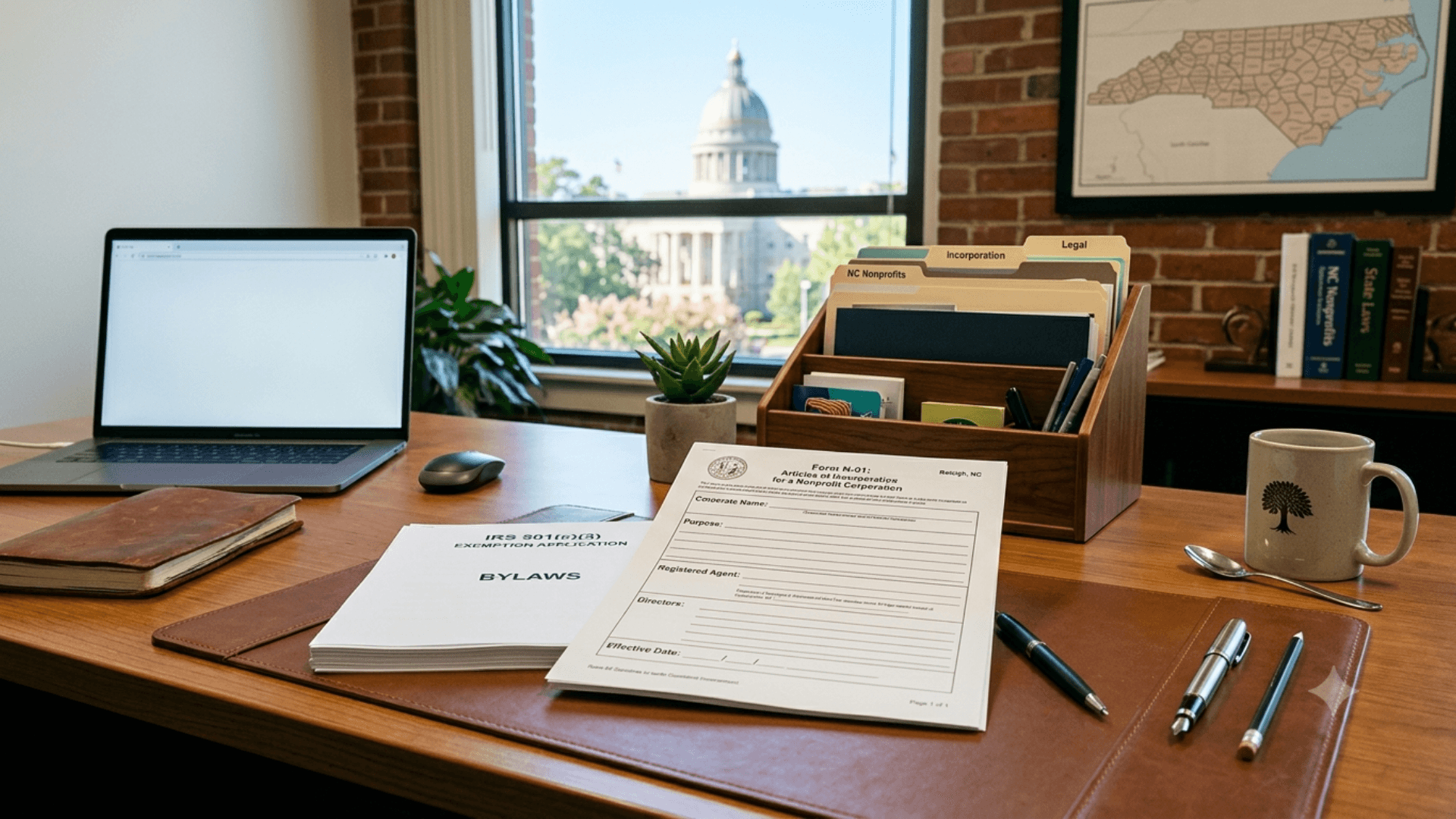
Filing your Articles of Incorporation is the moment your North Carolina nonprofit becomes a legal entity. Get this document wrong, and your entire 501(c)(3) application can be rejected months later.

North Carolina Nonprofit Annual Report: Filing Requirements, Deadlines & Fees
North Carolina nonprofit compliance just changed. Starting January 1, 2027, every Chapter 55A nonprofit corporation in the state must file an annual report with the NC Secretary of State, making it critical for organizations to understand exactly what is required, when it is due, and what happens if they miss it.
How to Get 501(c)(3) Tax-Exempt Status in North Carolina?
Getting 501(c)(3) status in North Carolina means clearing two separate hurdles: state incorporation and federal IRS approval. Here's the exact sequence, the NC-specific paperwork, and the costs involved.

North Carolina Nonprofit Tax Exemption: Sales Tax, Income Tax & Requirements
Getting 501(c)(3) status from the IRS does not automatically make your organization tax exempt in North Carolina. This guide breaks down exactly what nonprofits owe, what they can recover, and how to stay compliant with state rules.

North Carolina Nonprofit Board Requirements: Directors, Officers & Governance Rules
A clear look at how many directors North Carolina law requires, what officers you need, and the governance rules that keep your nonprofit compliant and fundable.
Get Nonprofit Tips and Compliance Guidance
Subscribe for updates, insights, and resources that help you stay compliant and grow your mission.