How to Apply for Grants as a Georgia Nonprofit
Key Takeaways
You must hold an active 501(c)(3) status and a Georgia Charitable Solicitation Permit before applying for most grants
A "grant-ready toolkit" (IRS letter, bylaws, board list, budgets) is required by nearly every Georgia grantmaker
Georgia has community foundations, state portals, and corporate foundations that fund nonprofits at every stage
Federal applicants must register on SAM.gov for a free Unique Entity Identifier (UEI)
Strong applications focus on measurable community impact — not buzzwords
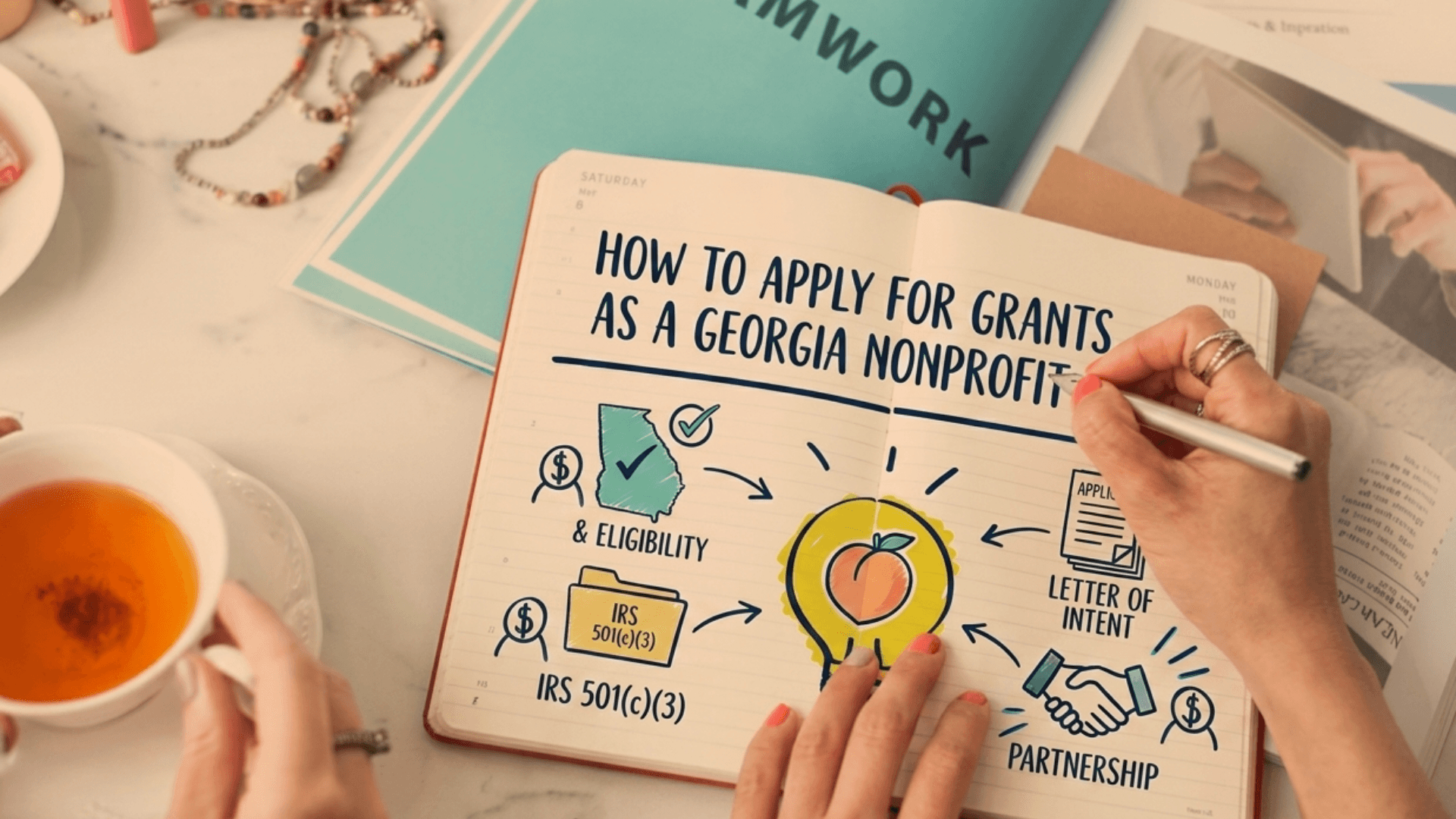
You've built your nonprofit from the ground up, the mission is clear, the community need is real, and your team is ready to do the work. But without funding, even the strongest programs stall before they start.
If you're wondering how to apply for grants as a Georgia nonprofit, you're in exactly the right place. This guide walks you through every practical step, from making sure your organization is legally grant-ready to finding the right funders in Georgia to submitting an application that actually gets read.
Whether you're a brand-new nonprofit or an established organization looking to diversify revenue, Georgia has a rich and accessible funding landscape if you know how to navigate it.
Step 1: Make Sure Your Organization Is Grant-Ready
Before you write a single word of a grant narrative, your legal and financial house needs to be in order. Georgia grantmakers—whether a community foundation or a state agency—will check these basics before they even open your application.
Legal Compliance Checklist
| Requirement | Where to Get It |
|---|---|
| Active 501(c)(3) Status | IRS (irs.gov) |
| Registered with the Georgia Secretary of State | Georgia SOS (sos.ga.gov) |
| Charitable Solicitation Permit | Georgia SOS Charities Division |
| Good Standing Certificate | Georgia SOS |
The Charitable Solicitation Permit is one requirement many new nonprofits overlook. Under Georgia law, most nonprofits must register with the Secretary of State's Charities Division before soliciting donations or applying for grants from Georgia-based foundations. Certain organizations qualify for an exemption, but you must verify this directly through the Georgia Secretary of State's office.
501(c)(3) Status is the non-negotiable baseline. Nearly every grant application in Georgia, private, corporate, or government, will ask for your IRS Determination Letter.
Step 2: Build Your Grant-Ready Document Toolkit
Think of this as your grant application starter pack. Assemble these documents into organized PDFs before you begin any applications—most Georgia portals require uploads at the time of submission, and missing a single attachment can disqualify you.
Core Documents Every Georgia Grantmaker Requires
- IRS 501(c)(3) Determination Letter — proof of federal tax-exempt status
- Organization Bylaws — current, signed, and dated
- Board of Directors List — including names, professional affiliations, terms, and meeting attendance rates
- Board Authorization Letter — a signed letter confirming the board approves the specific grant request
- Annual Operating Budget — current fiscal year revenue and expense breakdown
- Project-Specific Budget — line-item detail showing exactly how grant funds will be used, alongside any matching funds
- Recent Financial Statements or IRS Form 990 — most funders request the last 1–3 years
- Unique Entity Identifier (UEI) — mandatory for any state or federal funding; register free at SAM.gov
Pro Tip: Create a shared folder with all these documents clearly labeled and updated quarterly. Grant deadlines move fast; the organizations that apply quickly are the ones who were already prepared.
Step 3: Identify the Right Grant Opportunities in Georgia
Not every grant is the right grant. Applying to funders whose priorities don't match your mission wastes time for everyone. Here's where Georgia nonprofits should focus their search.
State & Federal Grant Portals
Georgia Grants Portal — Run by the Governor's Office of Planning and Budget, this is the central hub for tracking open state funding opportunities. Bookmark it and check it regularly: opb.georgia.gov
Grants.gov — The federal clearinghouse for all U.S. government grant opportunities. Use the advanced search filters to narrow by CFDA number, eligibility, and category relevant to your mission.
Georgia Community Foundations
Community foundations are often the most accessible entry point for small and mid-sized nonprofits. They fund local programs, have dedicated nonprofit grant cycles, and are deeply invested in Georgia communities.
| Foundation | Region | Notable Program |
|---|---|---|
| Community Foundation for Greater Atlanta | Metro Atlanta | Grants for arts, education, and health |
| United Way of Greater Atlanta | Metro Atlanta | Community impact grants |
| Community Foundation of Central Georgia | Central GA | Nonprofit Grant Program |
| North Georgia Community Foundation | North GA | Local nonprofit support |
| Cobb Community Foundation | Cobb County | Regional grants |
Each of these foundations runs its own application portal. Register your nonprofit profile early—new account approvals typically take one to three business days, and many portals close applications once the deadline passes, regardless of registration status.
Georgia Corporate & Legacy Foundations
Some of Georgia's largest employers and legacy institutions offer structured grant programs for nonprofits.
Georgia Power Foundation — Focuses on community impact grants typically under $25,000, evaluated on an ongoing basis. Strong preference for projects with measurable local outcomes.
The Robert W. Woodruff Foundation — One of Georgia's most significant private foundations, focusing on metro Atlanta and large-scale capacity building, capital projects, and systems-level change. Highly competitive.
Georgia's Own Foundation — Offers both small and large grant cycles, specifically designed for Georgia-based nonprofit programs serving underserved communities.
Georgia Arts & Sector-Specific Grants
Georgia Council for the Arts — If your nonprofit operates in the arts, culture, or creative education, GCA offers project and operational funding based on peer review and your organization's budget size. Visit gaarts.org for current grant cycles.
Georgia Center for Nonprofits (GCN) — GCN is not a grantmaker itself, but it maintains a robust resource hub at gcn.org listing curated funding opportunities, grant workshops, and funder connections across the state.
Step 4: Write and Submit a Strong Application
Finding the grant is only half the work. Here is how to make your application stand out.
What Every Strong Georgia Grant Application Includes
A clear problem statement — Ground your narrative in real Georgia community data. Reference local statistics where possible and cite public sources like the Georgia Department of Community Health or the U.S. Census Bureau to establish credibility.
Measurable outcomes — Funders want to know what success looks like. Replace vague goals like "help more families" with specific metrics: "provide after-school tutoring to 120 students in Fulton County, targeting a 15% improvement in reading proficiency scores."
A realistic project budget — Your numbers must add up. Show the full project cost, what you're requesting from this funder, and any confirmed matching funds or other revenue sources.
A sustainability plan — Most grantmakers want assurance that their investment won't disappear after year one. Explain how the program will continue through earned revenue, other grants, or community partnerships.
What to Avoid
- Buzzwords like "game-changer," "innovative," or "cutting-edge"—they signal a lack of substance
- Vague impact language without metrics
- Misaligned project descriptions (if the funder funds food access and your project is job training, don't force the connection)
- Incomplete attachments—A missing document is an immediate disqualifier on most digital portals
Georgia-Specific Rules to Know Before You Apply
Georgia has a few compliance requirements that catch nonprofits off guard:
1. Charitable Solicitation Registration
Must be renewed annually with the Georgia Secretary of State. Lapsed registration can disqualify your application mid-review.
2. UEI is mandatory
For any pass-through federal or state funds in Georgia—not optional. Register at SAM.gov well before your deadline since processing can take several days.
3. Form 990 is public
Georgia foundations will look yours up. Make sure your most recently filed 990 accurately reflects your current programs and financials.
4. Portal registration timelines vary
The Community Foundation for Greater Atlanta and other regional foundations may require up to a week for new organizational profiles to be fully approved. Don't wait until the deadline week.
If you're still in the process of building your nonprofit's legal structure, our complete guide on how to start a nonprofit organization in Georgia in 12 steps covers everything you need — from incorporation to IRS approval — before your first grant application goes out the door.
Final Thoughts
Securing grant funding in Georgia is absolutely achievable—but it requires preparation. The nonprofits that consistently win funding aren't necessarily the largest or most established; they're the ones that show up organized, mission-focused, and clear about the impact their work creates in Georgia communities.
Start with your legal foundation. Build your document toolkit. Target funders whose priorities match yours. Then write applications that let your community impact speak louder than your marketing language.
And to help you accomplish all this, Beacon Nonprofit is here to help you!
Frequently Asked Questions
Get Nonprofit Tips and Compliance Guidance
Subscribe for updates, insights, and resources that help you stay compliant and grow your mission.